National Museum of the American Indian in Washington DC

| | | | |

We recently visited the National Museum of the American Indian in New York City (read about our adventures here) and less than a week later we were in Washington DC and spent a few hours (and a yummy lunch!) at the National Museum of the American Indian in Washington. You can also read about our adventures at several other Washington DC museums here.

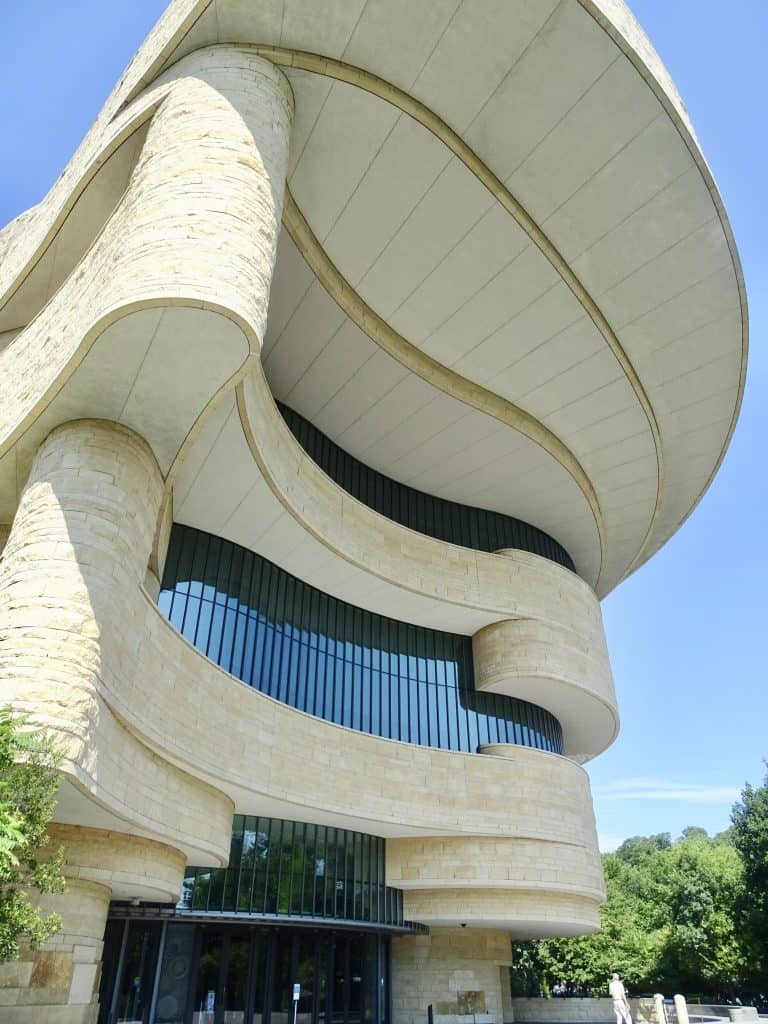
Both museums are part of the Smithsonian Institute and feature the history of indigenous peoples throughout the Western Hemisphere. The DC museum is located on the National Mall and has four floors of exhibits including a massive family activity center on the third level. There are also several spots throughout the museum for presentations, musical performances, and seminars. The Mitsitam cafe is a must visit- several unique options for lunch and a great opportunity for children to try different foods from around the world. (and yes, they even have chicken fingers as a back up!)
Traveling with Kids:

  • The museum is FREE to visit 364 days a year (closed on Christmas)
  • Do NOT visit the museum with children on Mondays- the imagiNATIONS exhibit (which children will LOVE) is closed on Mondays. My children were so sad we missed the chance, especially since we loved the New York version
  • There is very limited metered street parking. A better option is to take a metro line to the L’Enfant Plaza stop. Walk two blocks towards the Smithsonian museums.
  • All visitors must pass through bag inspection and metal detectors.
  • The entire museum is handicap accessible and strollers are allowed.
  • The Roanoke Museum Store is located on the second floor and has many native themed souvenirs such as books, jewelry, and home decor.
  • The Mitsitam Cafe offers food from five regions of the Americans traditionally prepared (and chicken fingers and fries as a backup for kids) cafeteria style with a beautiful dining room looking out over the water features outside. There is an espresso coffee bar outside of the Cafe. 

Play “I Spy” in the Museum of the American Indian:

1. Start on the 4th floor with a 13 minute introductory video entitled Who We Are in a 360 projection Lelani Theater.

2. Look for tribal artifacts and attire and listen to folk tales in the Our Universe exhibit (4th floor)

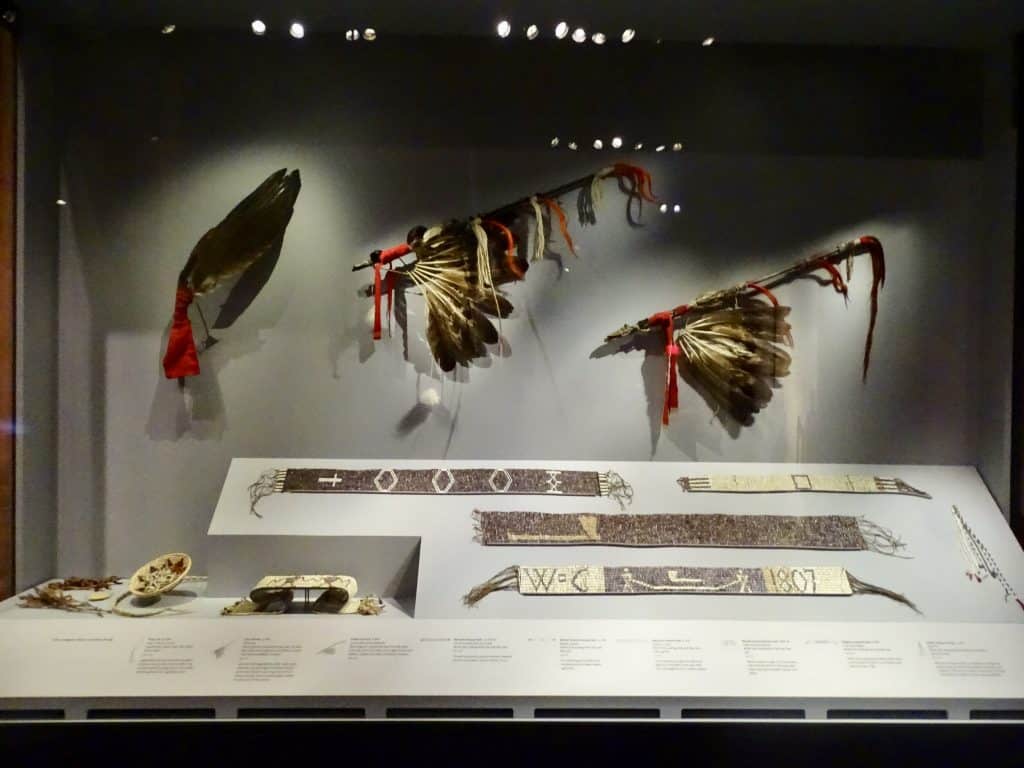
3. Read about eight treaties signed between the United States and Indian Nations and pick a favorite calumet (which represents a sacred badge of friendship and is used in treaty meetings) in the Nation to Nation exhibit.  Each display shares the perspective of both the native nations and the United States. (4th Floor)

Would you like to save this?

We'll email this post to you, so you can come back to it later.

4. Locate information about the hundreds of commonly used items with ties to Native American tribes in the Americans exhibit. Items such as Land O Lakes butter are displayed and interactive touch screens provide more in depth background (use the call number displayed next to each item to research). Try the “surprise me” button for randomly selected information. 

5. Find out the true story of Pocahontas in the Americans exhibit (3rd floor).

6. Follow the massive timeline (starting in 1000 BC through AD 1600) of the Andean cultures from Colombia and Ecuador to Peru and Argentina in the The Great Inka Road exhibit. There are lots of interactive touch screens and maps and a massive replica suspension bridge in Peru.

7. Learn about Section 14, a square mile section of land that is considered the spiritual center of the Agua Caliente people, who have lived there since 1876.

8. Compare the features of four canoes in the Potomac Atrium lobby exhibit.

9. Eat at the Mitsitam Cafe and try the Pueblo taco or New Mexican Red Chile- our favorite dishes.

10. Spend at least an hour in the imagiNATIONS exhibit, where kids stamp a passport as they complete various activities including arts and crafts (which guests can take home), walking in snowshoes, and basket weaving. There is also a large reading nook with tons of beautifully illustrated books for all ages and reading levels. Grab an Our Universe Family Guide, which provides guidelines on what to look for in the exhibit and provides additional information on specific artifacts.

Looking for other adventures in Washington DC? See our index of posts here, our full Washington DC City Guide here, and our posts featuring the Kennedy Center for Performing Arts, the National Zoo, the Library of Congress, the Smithsonian American Art Museum and National Portrait Gallery, the National Museum of American History, the National Museum of African American History & Culture, the International Spy Museum, the National Building Museum, the National Postal Museum, and Mount Vernon. And follow along on our adventures on Instagram, Facebook, Pinterest, and X.

Similar Posts

  • | | | |

    Playing “I Spy” at the Connecticut State Capitol

    Visiting state capitol buildings is one of the first things we do when visiting the capital city. It’s a little ironic that it took our family, who has lived in Connecticut for almost 20 years, this long, but we recently, finally made it to the CT Capitol for a tour.

    Connecticut was founded in 1662 and is known as the Constitution State, as it was the first state to adopt a constitution.  Built in 1878, the Connecticut Capitol building, located in downtown Hartford, was designed by Richard M. Upjohn to replicate a Victorian Gothic style. The building overlooks Bushnell Memorial Park’s 41 acres in the heart of Hartford and was restored in the 1980s to the original colors and design. The addition of the Legislative Office Building (LOB), which opened in 1988, allowed for office space for Connecticut’s 151 Representatives (each representing approximately 25,000 constituents)  and 36 State Senators (each representing approximately 90,000-100,000 constituents). The “LOB” also allows for more public meeting spaces and opportunities for state officials to meet as committees and with public interest groups. The first and second floors of the LOB and the first floor of the Capitol are both open to the public; upper level floors house private offices and chambers and guests must be accompanied by officials. 

  • | | |

    Five Ways to Explore the Jupiter Inlet Lighthouse & Museum in Jupiter, Florida

    We’ve explored Palm Beach County, Florida many times when visiting family in Delray Beach. This past trip, we finally had time to stop at the Jupiter Inlet Lighthouse and Museum that we’ve passed several times and enjoyed exploring the ever expanding complex.

    Operated by the Loxahatchee River Historical Society, the first lighthouse museum opened in 1973 and now welcomes over 800,000 visitors to the complex each year. The nonprofit manages the 1860 Jupiter Inlet Lighthouse and Oil House, 1892 George Washington Tindall House, 1929 Lighthouse Keeper’s Workshop, and 1940 Naval Housing Building (currently closed due to nearby bridge construction). The lighthouse and museums are located on a complex, owned by the town of Jupiter, which also include large sports fields, nature trails, and a large playground. 

  • | | | |

    Boston Symphony Orchestra in Boston, Massachusetts

    Founded by Henry Lee Higginson, the Boston Symphony Orchestra (BSO) was first located at the site of the current Orpheum Theater and then moved to its current location in 1900. Higginson spent significant time studying European orchestras before creating the BSO in 1881 and the Boston Pops in 1885. Higginson wanted to mimic the Coliseum in Greece, as Boston was considered the Greek “Athens” of America, and included 16 Greek statues of figures related to the arts around the hall.

  • | | | | |

    Nine Ways to Explore Nemours Estate in Wilmington, Delaware

    Nicknamed the “Versailles of the Brandywine Valley”, Nemours Estate is the 77 room mansion that Alfred I. duPont built for his second wife, Alicia, between 1909-1910. Nemours is also home to the largest French formal garden in North America. (Guests can learn all about the 10 design elements of a French garden on the tram tour). Alfred I. duPont was the great grandson of E. I. du Pont, founder of the DuPont Company, which began in Wilmington in the early 1800s.

  • | | | | | |

    10 Things to Do at Spyscape in New York City

    It’s one of our holiday traditions to make it into Manhattan for some holiday fun. We always enjoy seeing the lights, decorated windows and, of course, the trees. Each year, we also pick one new activity to do. This year, it was Spyscape. I can guarantee we’ll be going back.

  • | | | |

    Smithsonian American Art Museum and National Portrait Gallery in Washington, D.C.

    Disclaimer: I have chosen to continue my weekly blog posts sharing our recent adventures exploring America. Our family has been safely quarantined for over a month and we will continue to do so until it safe to head out on our next adventure. The travel tips and recommendations we share were current at the time of visitation in 2019-2020. We recommend helping our country (and world) by staying home and planning for future adventures. We hope these posts bring you inspiration and motivation to plan your next trip!

    One of the oldest buildings in Washington DC and now a National Historic Landmark building, The Donald W. Reynold Center for American Art and Portraiture is home to both the Smithsonian American Art Museum and National Portrait Gallery. The complex first opened to the public in 1968 and completed renovations in the early 2000s. Both institutions, overseen by the Smithsonian Institute, are housed in the same complex. The Portrait Gallery has over 23,000 pieces of art in its collection and began officially commissioning portraits of presidents, beginning with George H.W. Bush. The American Art Museum is home to one of the largest collection of American art in the world and includes The Luce Foundation Center for American Art, housed on the 3rd floor. The Luce collection has more than 3,000 pieces of art in mediums from paintings to sculptures to medals to jewelry.

Leave a Reply

Your email address will not be published. Required fields are marked *