Touring the Wang Theatre at Boch Center in Boston

| | | |

On a recent trip to Boston (we’ve got dozens of posts featuring popular Boston attractions), we finally had the chance to tour of Boston’s most famous venues: The Wang Theatre at the Boch Center.

The Wang Theatre at the Boch Center opened in 1925 as the Metropolitan Theater in the heart of downtown Boston. Over 100 artists came from Italy to complete the painting and sculpture work throughout the theater (look for the lead artist’s, Louis Amorosi, name inscribed in the corner of the ceiling). The fourteen floor building opened as a movie theater with over five thousand seats (the theater routinely oversold tickets and if a patron got up from their seat to use the restroom or buy refreshments, someone quickly took it). The theater stayed open all day for guests to patronize the art exhibits, play games, and socialize. 

In the 1960s, the theater was bought and changed names to The Boston Music Hall, with an emphasis on showcasing music and concerts- the first concert was the Beach Boys! In 1982, the building was sold again to the Tufts Medical Center, and today, the Wang Theater remains the only major musical theater housed inside a medical center. It is named for Dr. An Wang who helped save the space. Dr. Wang is credited with inventing the computer (long before Steve Jobs and Bill Gates) by founding the Wang Laboratories company in Lowell, Massachusetts. Dr. Wang donated four million dollars to help restore the building to its original beauty, including modernizing the original elevators (The Wang was the first theater in Boston to have elevators).

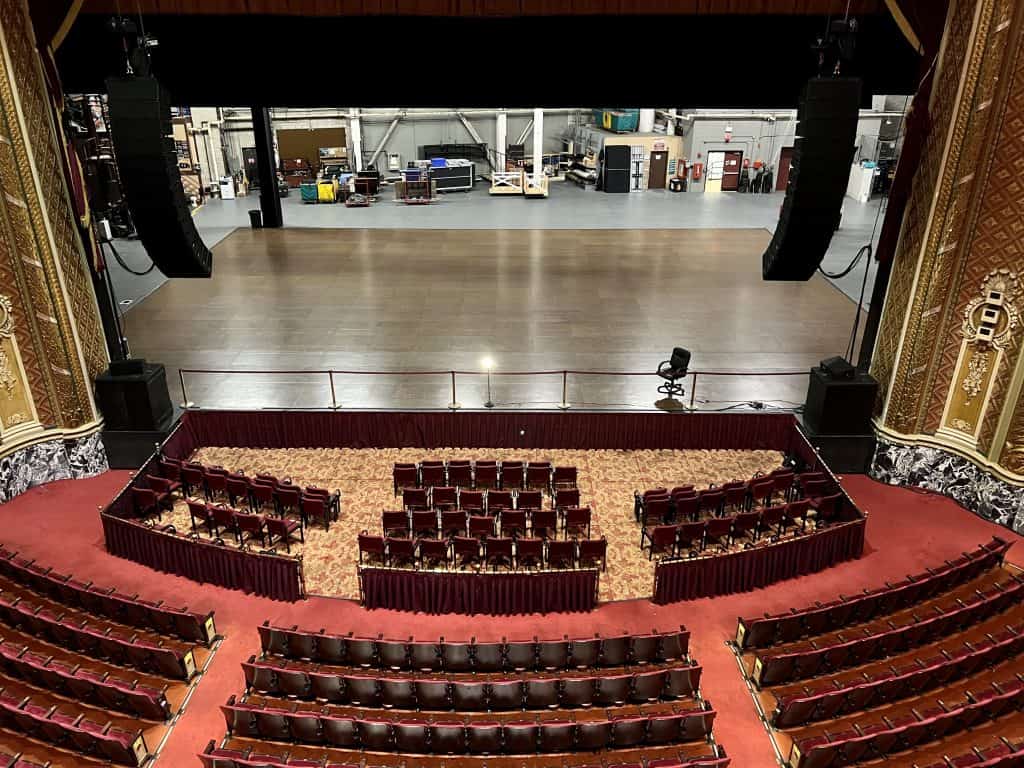
Today, the Wang Theatre, with 3,500 seats and one of the largest stages in America, hosts productions close to 200 days a year, with a heavy emphasis on family friendly programs and the recent addition of more dance and comedy acts. The organization is in the process of building the Folk Americana Roots Hall of Fame that highlights Boston’s rich and storied musical history, with exhibits throughout the Boch Center. Some exhibits can only be viewed while on the tour, but some exhibits are accessible before shows and during intermission. 

Would you like to save this?

We'll email this post to you, so you can come back to it later.

Travel Tips:

  • Guided tours are offered on select days each week, based on performance schedules- typically at 10am, 12pm, and 2pm. Check here for up to date information and reservations for tours. 
  • The closest parking option is the attached Tufts Medical Center Garage. There are several other parking garages less than a half mile from the theater- check here for more information. 
  • Restrooms are available on the second level of the theater (with a stop on the tour). Tours are handicap accessible
  • There are tons of restaurants near the Boch Center; a good list can be found here. We had a great lunch at Maggiano’s Little Italy, less than a half mile away ($15 for a two course lunch!)
  • Plan on 60-75 minutes for a guided tour.

Ten Stops on the Tour of the Wang Theatre:

  1. The ticket center and Main Lobby– look up at the beautiful ceilings hand painted by Italian artists. 
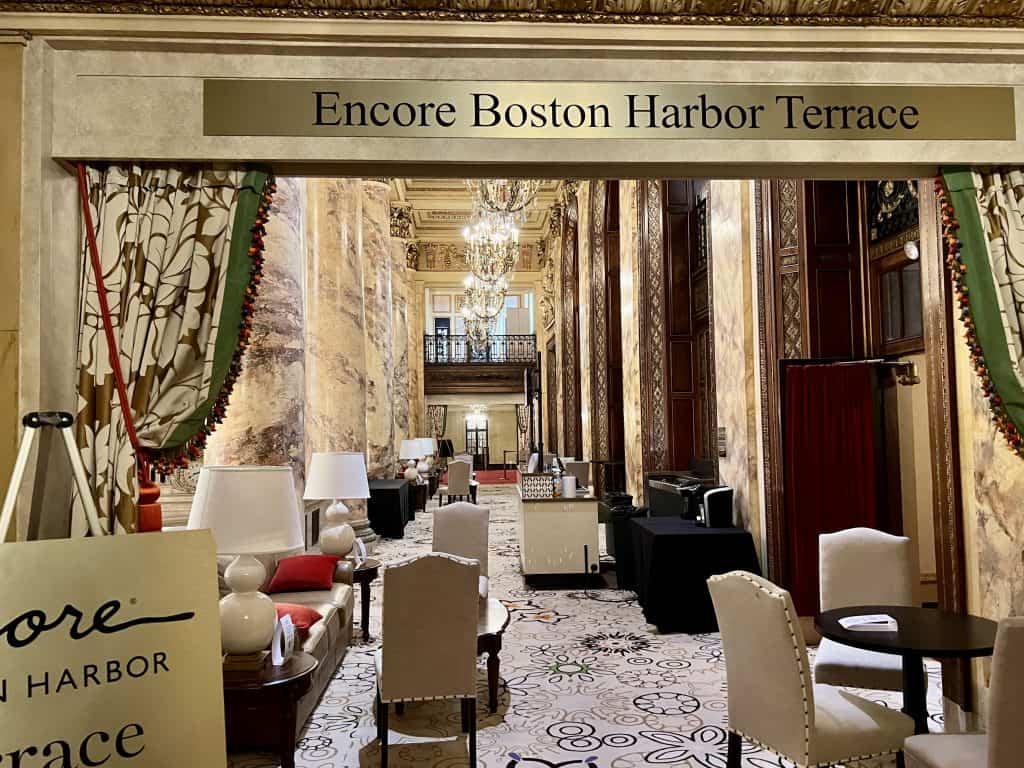
  2. The Grand Lobby, modeled after Paris’s Garnier Opera, with two, original chandeliers, each weighing over one thousand pounds! The chandeliers can be raised and lowered to be cleaned and replace lightbulbs.
  3. The Boston: A Music Town exhibit on the 3rd floor mezzanine that spans an entire hallway and showcases seven genres of music: folk, country, classical, bluegrass, jazz, R&B/hip hop, and rock. Displays include musicians’ instruments, apparel, records, and memorabilia from concerts and tours. 
  4. The theater, with 3,500 seats on seven levels of seating. Be sure to look up at the 12 restored paintings (on canvases) that were restored in the 1980s restoration project and reafized to the ceiling and side panels of the theater. Two of the panels were destroyed and when they were recreated, the restoration company added (with permission!) the face of the longest Wang Theater Director and the faces of the restorators. 
  5. The Platinum Salon on the lower level. In the 1930s-1950s, the Salon was a Dance Hall; now is another exhibit of the Folk Americana Roots Hall of Fame entitled “Cultural Heroes. The exhibit includes seven sculptures of Civil Right musicians: Bessie Smith, Woody Guthrie, Billie Holiday, Huddie Ledbetter, Marian Anderson, Josh White, and Paul Robeson. The Platinum Salon also has a Lego reproduction of the Wang theater (ten thousand legos!)
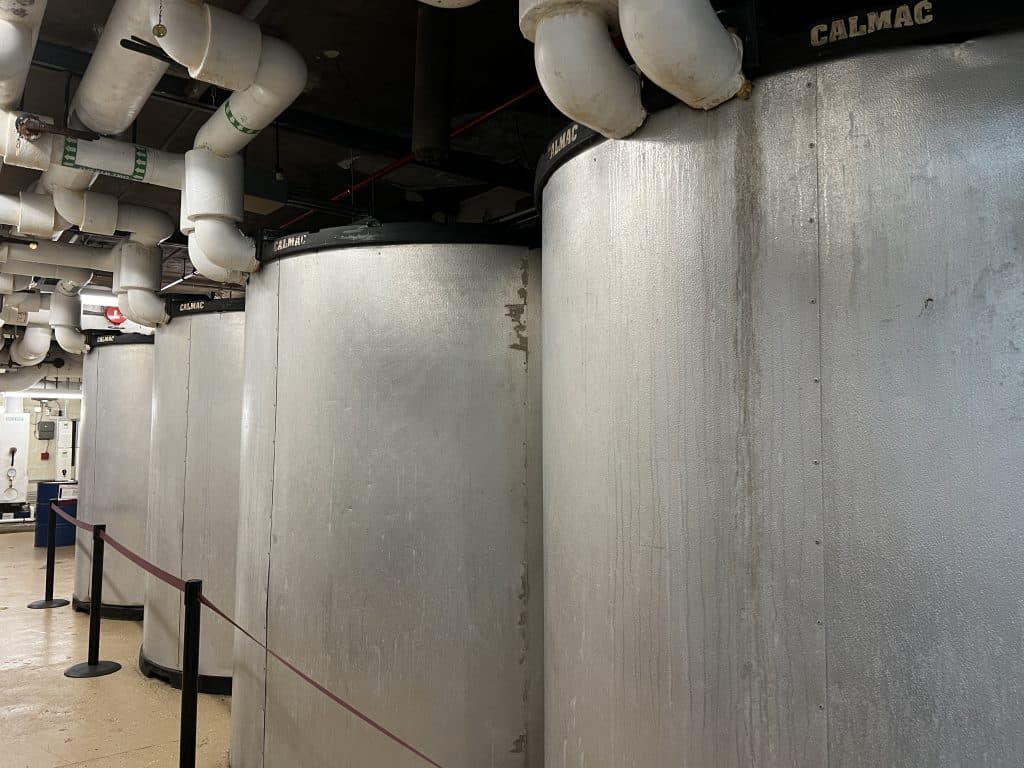
  6. The Ice Room filled with 18 Thermal Energy Storage tanks that are filled with cool water that is pumped to fans (in use since 1925) to cool the theater.  
  7. The Choral Dressing Room, the largest dressing room in the theater.
  8. The backstage Hall of Signatures covered in signatures of the casts of past shows.
  9. The double VIP Room with rotating exhibits of the Folk Americana Roots Hall of Fame. In the summer of 2023 the exhibit featured the life and guitar of Arlo Guthrie, son of Woody Guthrie. It includes an AI HoloConnect that allows visitors to interact with Guthrie and ask virtually any questions. An exhibit featuring Bruce Springsteen is planned for 2024. Check here for information on rotating exhibits. 
  10. The stage of the theater, one of the largest in North America.

Looking for other adventures in Boston? Check out our index of over two dozen posts here. Looking for tours of other music venues? Check out our posts featuring the Boston Symphony, Radio City Music Hall in New York City, Carnegie Hall in New York City, Met Opera House in New York City, and The Bushnell Performing Arts Center in Hartford, Connecticut. And follow along on our adventures on Instagram, Pinterest, Facebook, and Twitter.

Disclosure: Our family was given a media pass for a tour; all opinions expressed are my own.

Similar Posts

  • | | |

    Please Touch Museum in Philadelphia, PA

    The Please Touch Museum is one of the most popular spots for kids of all ages in Philadelphia- up to 5,000 people visit each (busy) day! The museum is located inside Memorial Hall, site of the Art Gallery for the 1876 Centennial Exhibition celebrating America’s 100th birthday. There is over 60,000 square feet of exhibits open to the public and various classrooms and meeting spaces. The museum is best for ages ten and under, but there are many exhibits even older children will enjoy. The best part? Visitors are encouraged to “touch” everything!

  • | | | | | |

    The Hew Hampshire State House in Concord, New Hampshire

    The New Hampshire State House, located in the capital city of Concord, is the home base of New Hampshire’s 24 State Senators, each Senator representing 55,000 residents, and 400 House Representatives, one for every 3,500 residents. State House members have other full time jobs and several college student members are current House members (the minimum age to be a House Representative is 18 years old). The House Chamber, 204 years old (in 2023) is the oldest, continuously used House Chamber in the United States- the only additions over the years have been carpet, electricity, and female representatives.   The original State House was built between 1816-1819, with additions in the 1860s and the addition of elevators and restrooms in 1910.

  • | | |

    15 Ways to Explore the Crane Estate on Castle Hill in Ipswich, Massachusetts

    On a recent visit to the North Shore of Massachusetts, we explored one of the most beautiful Gilded Age estates, the Crane Estate, set high on a hill above one of the most beautiful beaches, Crane Beach, in Ipswich, Massachusetts. The estate has been carefully restored and preserved by the Trustees, who oversee more than 100 properties throughout Massachusetts. 

    The Crane Company, founded by Richard Teller Crane, in 1855 was well known for their brass fixtures and bells, most famously used to help build the Golden Gate Bridge in San Francisco.  Later, his son, Mr. Richard T. Crane, who focused the company on manufacturing various bathroom fixtures, purchased Castle Hill and began renovating and expanding the property. The Cranes, who were based in Chicago, had summer homes in London, England and Jekyll Island, Georgia. The first home on the Ipswich property was built in 1912 but later torn down as it was properly outfitted to withstand the elements of the nearby ocean. The current estate, with 59 rooms, was built in a timeless English style similar to the Cranes’ London estate and finished in 1929. Over the years, the Cranes restored over 3,500 acres in Essex Bay, Choate Island, and Ipswich. The estate also includes the 700 acre Crane Wildlife Refuge, made up of Castle Neck (which borders Crane Beach), five islands, and salt marshes.

  • | | | | | | |

    Five Things to Do in the Great Smoky Mountains National Park Besides Hiking

    I’m saying it from the start: I am not a hiker. Or a camper. I think I like to hike and camp. I think I like being in the wilderness and communing with nature. I think I like to be without technology and modern day conveniences like running water. But when push comes to shove, I like it for about a day.

    So here’s the disclaimer: I spent one day in the Great Smoky Mountains National Park. I want to be up front: you could spend weeks- months- inside this national park that spans over 500,000 acres across two states (Tennessee and North Carolina). But I know my limitations, and I knew at the start of an almost four week road trip it was going to be a marathon and not a sprint, so I couldn’t get burnt out right away. I researched the Great Smoky Mountains and found the most manageable places to explore that would still give me the sense of accomplishment of hiking/camping/communing with nature. Here’s what I recommend if you want to get a feel for the mountains without camping for days:

  • | | |

    Fort Adams in Newport, Rhode Island

    This is the 3rd post in a series detailing my recent visit to Newport, Rhode Island. To read about celebrating the holiday season in Newport, click here and to read about the International Tennis Hall of Fame, click here.

    Fort Adams has the honor of being both the largest fort in the United States and the only fort never attacked. Although, because it was never attacked or “officially in use”, it is not part of the National Parks program like many other forts throughout America. Fort Adams, located in Newport, Rhode Island, is one of twenty fortresses built after the War of 1812, took over 30 years (from 1820-1850) to complete, and is named after the second American President, John Adams. It was most effectively used as a training facility for West Point graduates before their official postings.

    The entire complex is a state park and open to the public, free of charge.  The public is welcome to use the restrooms, walk (leashed) dogs, fish, picnic, and even use the public beach. Sail Newport, housed on the property, rents sailboats and also gives lesson.

    On a recent visit to Newport, my family took the 90 minute, guided tours. We loved it. All of us, adults and children alike, found it interactive, informative, and even a little scary.  Steve Marino, our tour guide, made sure to engage our children throughout the tour.  You’ll need to start in the Visitor’s Center to purchase tickets. They offer a AAA discount. There are restrooms and a gift shop with snacks, drinks, and souvenirs. Strollers are allowed on most aspects of the tour, and you can leave strollers outside some “indoor” and tight spaces. 

  • | | | | |

    National Park Guide: Arches National Park in Utah

    Arches National Park in Moab, Utah, one of the most popular National Parks in America with two million visitors each year, is home to over 2,000 cataloged arches formed by erosion and weathering over the past 65 million years. Learn more about how the arches were formed here. Today, the park covers over 76, 000 acres and, in addition to the arches, is home to almost 500 species of plants, almost 200 species of birds, 50 species of mammals, 21 species of reptiles, and 6 species of fish (yes- fish!)

    We visited in June of 2021, during the still on going COVID pandemic, and there were some restrictions, mainly with the Visitor’s Center and programs. We highly recommend visiting early in the morning (being inside the park by 6am early), spending the morning hiking, and then leaving the park for lunch and a rest during peak afternoon sun. Later afternoon and evening will provide cooler temperatures and smaller crowds. Be careful to stay away from cactus and yucca plants, both of which are prevalent throughout the park. Both plants have sharp tips that can poke and easily puncture skin.

6 Comments

Leave a Reply

Your email address will not be published. Required fields are marked *