Five Ways to Explore the Woods Hole Science Aquarium on Cape Cod

| | | |

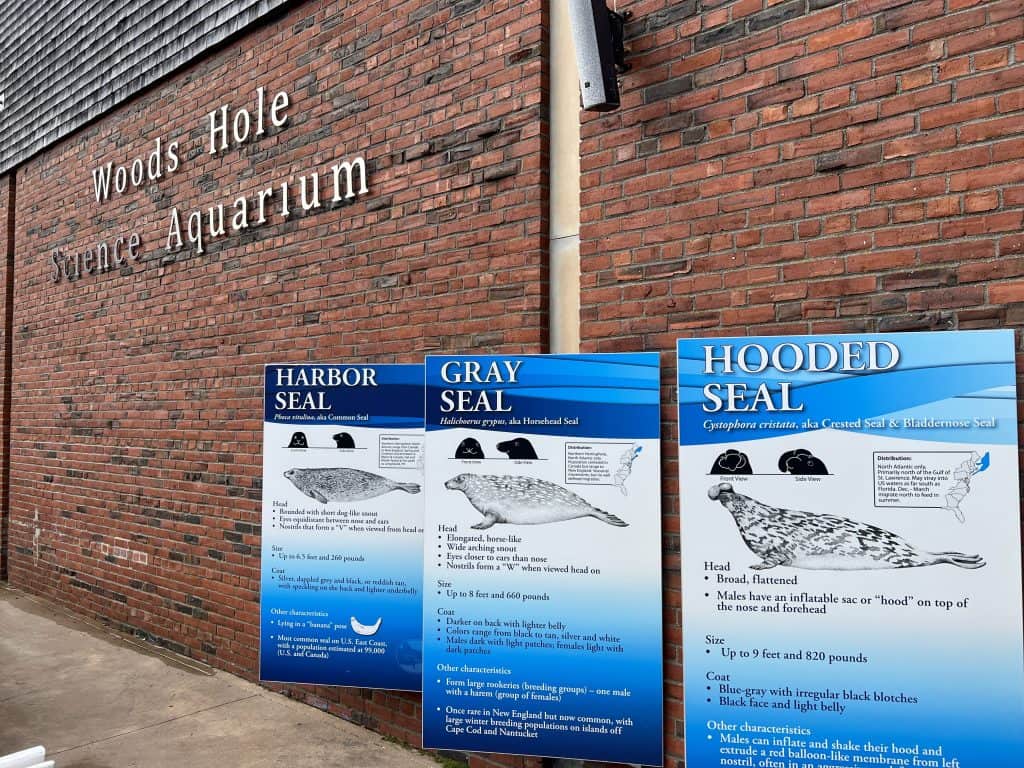
The Woods Hole Science Aquarium is part of the Woods Hole Oceanic Institute (WHOI), which is a nonprofit education facility that focuses on marine science and engineering. The WHOI has a campus spread out throughout the village of Woods Hole and it includes a Visitor Center and Discovery center, both of which are open to the public and offer a variety of programs and events. Opened in 1875 and welcoming over 80,000 visitors every year, the Woods Hole Science Aquarium is the oldest public aquarium in America and home to 140 species of marine life who live in the Atlantic and Northeast waters, including harbor seals.  The aquarium also has a rehabilitation program for sea turtles.
Travel Tips: 

  • The aquarium is FREE to visit and open year round, with more limited hours (and days) during quieter winter months; Check here for updated information on hours 
  • There is very limited free parking in front of the building- better bet is metered street parking and public transportation;
  • No strollers or food or drink allowed inside; there is one small flight of stairs to an upper level of touch tanks, but it is handicap accessible via a ramp in the back of the aquarium.
  • Restrooms located near the check in desk.
  • Information on other Woods Hole activities here and dining options here.
  • Kids will want to print out these activity sheets and bring them on their visit to the aquarium to complete.
  • Plan on 45-60 minutes to explore the exhibits. 

Would you like to save this?
We'll email this post to you, so you can come back to it later.

Using the Five Senses to Explore the Woods Hole Science Aquarium:

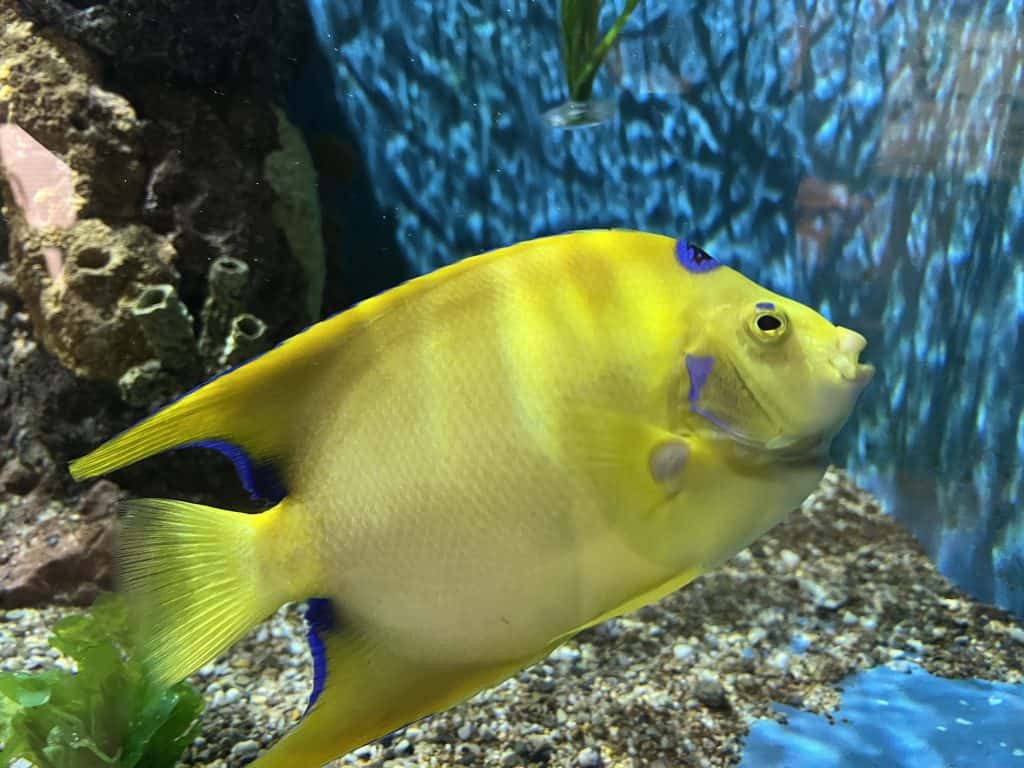
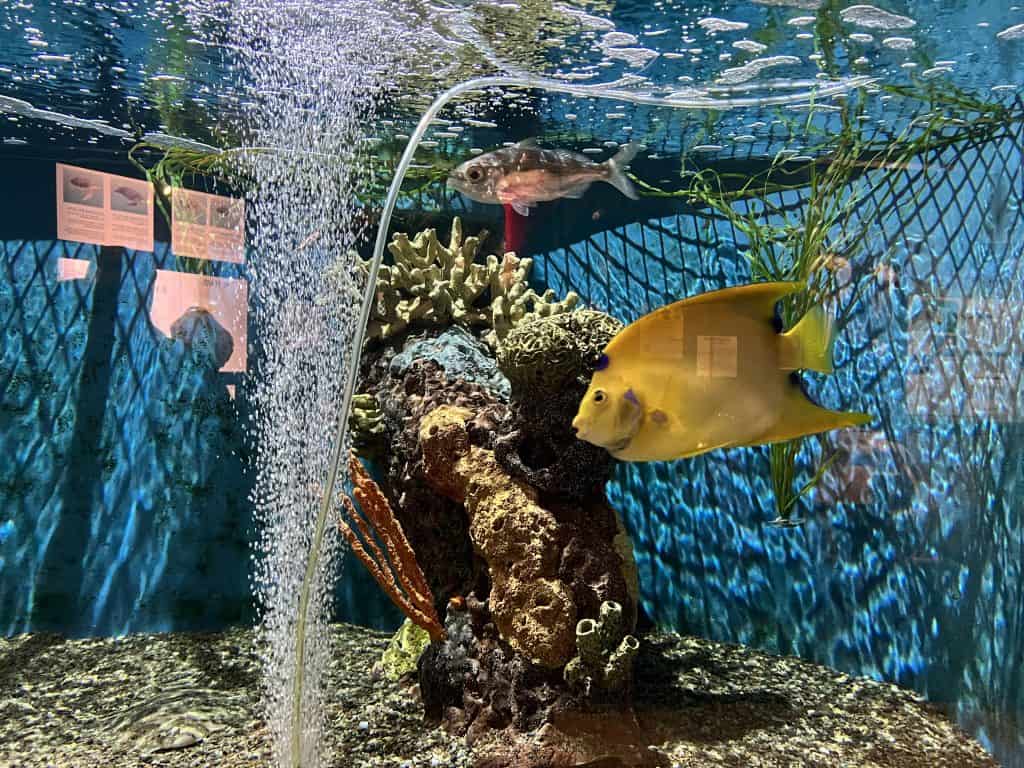
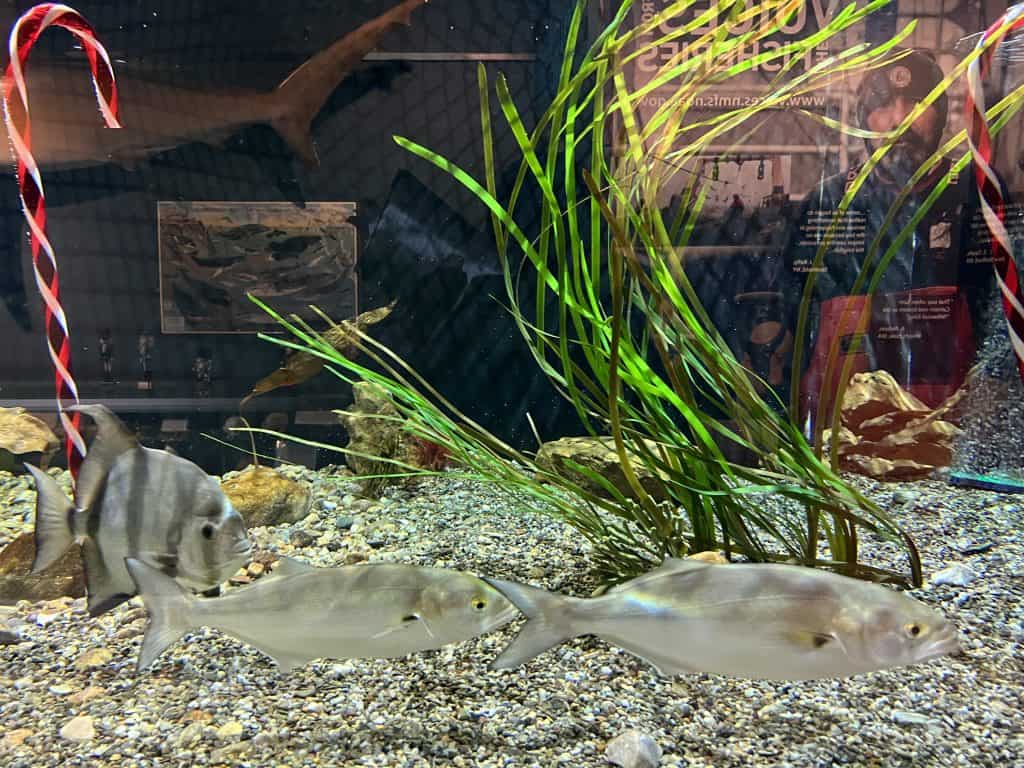
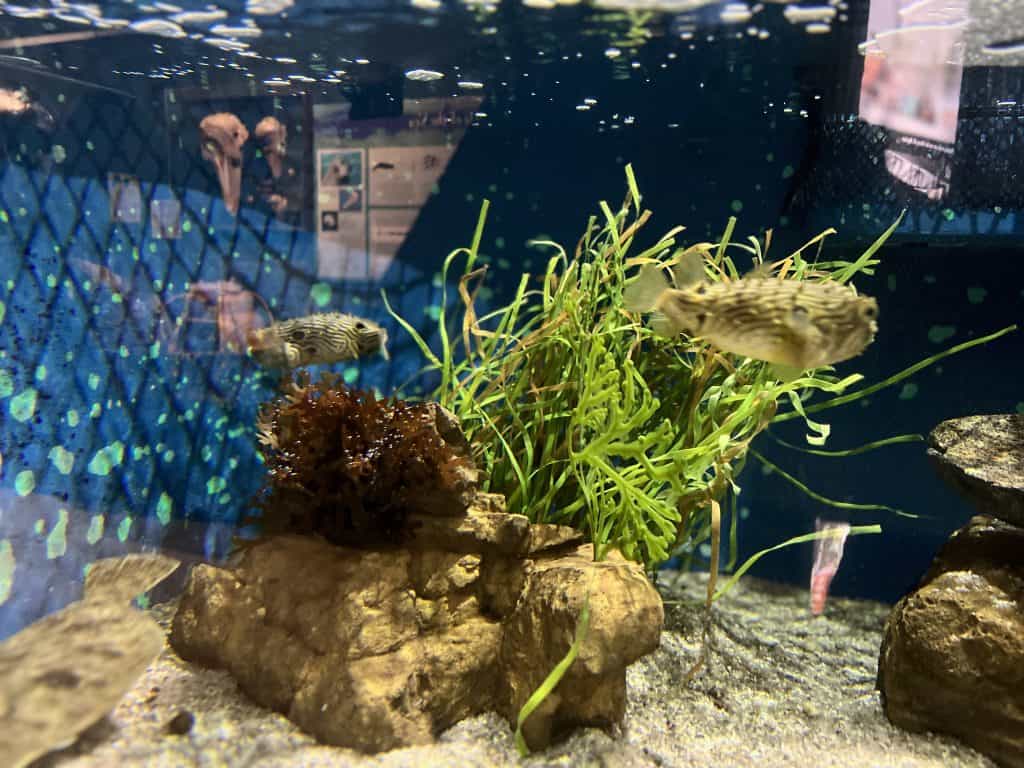
  1. Sight: Look at sea life up close in some of the 12+ tanks in the aquarium, home to dozens of sea life from the Northeast and Mid-Atlantic water, including a wide variety of fish, horseshoe crabs, sea urchins, skates, egg sacks, and underwater meadows. There are also exhibits with sea life skulls, bones, teeth. , as well as shells and bones from endangered turtles and whales.
  2. Smell: Smell the two harbor seals and see them up close in their outdoor, 17,000 gallon pool in the front of the building). Listen to one of the daily seal talks, usually offered a few times each day.
  3. Hear: Listen to the sounds of the seas, including harbor porpoises, sperm whales, and fin whales through recordings in some of the indoor exhibits.
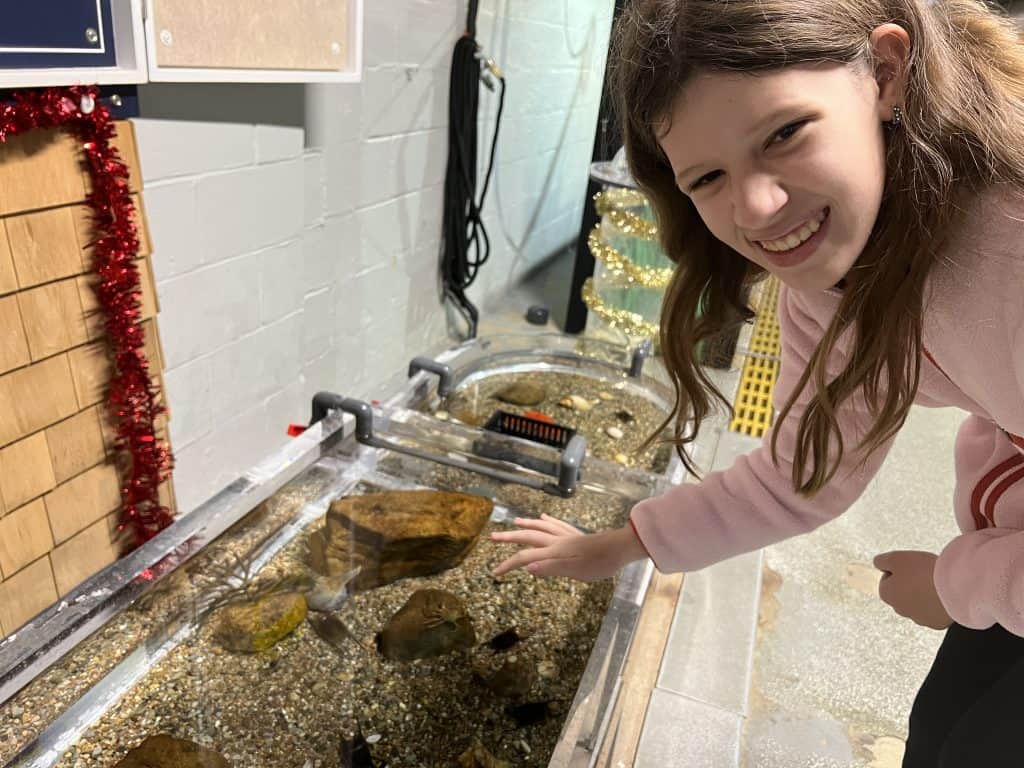
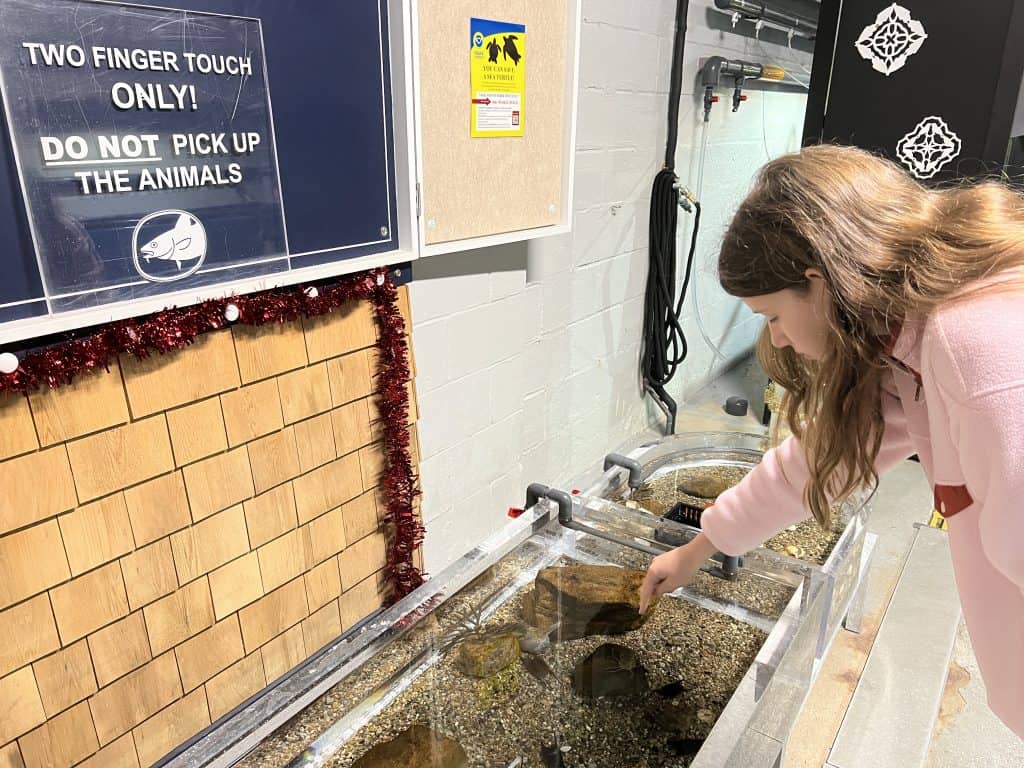
  4. Touch: Check out the touch tanks on the upper level of the aquarium, which includes various shells, shark eggs, sea stars, crabs, and whelks. The tanks are in the “work area” of the aquarium and visitors are welcome to watch staff prepare food to feed the animals and clean the tanks. Be sure to peek in the other side of the aquarium tanks from the lower level
  5. Read: (A bit of a stretch, but who really wants to taste anything at an aquarium?!) Read all about the history of the Woods Hole area, fishery science, whale protection, marine turtles, and the local inhabitants of the water. 

Looking for more adventures on Cape Cod? Check out our full Cape Cod During the Winter City Guide and our posts featuring the Cape Cod National Seashore, the Whydah Pirate Museum, the Cape Cod Museum of Natural History, Heritage Museums and Gardens, Ocean Edge Resort and Spa, and Pilgrim Monument and Provincetown Museum. And follow along on our adventures on Instagram, Pinterest, Facebook, and Twitter

Similar Posts

  • | | |

    The Farmer’s Daughter in South Kingstown, RI

    I grew up on the South Shore of Massachusetts, right between Boston and Cape Cod and my parents and sister’s family still live there. Now living in southwestern Connecticut with my family, we’re always looking for places off Interstate 95 to meet for the day. Westerly, Rhode Island is exactly halfway between our home towns and we’ve found fun things to do in Westerly- look for a post soon on Westerly through the seasons.

    However, this past week we wanted to try something new. I had bookmarked my friend Sarah’s CTinStyle blog post on The Farmer’s Daughter, a garden center, in nearby South Kingstown, Rhode Island last year. I remember Sarah describing the beautiful displays, impressive selection, and attention to detail. I checked The Farmer’s Daughter’s website, and when I saw the promise of lots of family centered fun, it was a done deal.

  • | | | | |

    Five Ways to Explore the South Street Seaport Museum in New York City

    Founded in 1967, the South Street Seaport Museum honors the legacy of one of the busiest seaports in the world, New York. Located in the heart of the historic Seaport District in downtown Manhattan overlooking the East River and the Brooklyn Bridge, the museum campus includes indoor exhibits, a fleet of vessels docked at adjacent Pier 16, a print shop, and tons of weekly and seasonal programs, sailing excursions, and family friendly activities. 

  • | | | |

    10 Ways to Explore the Florence Griswold Museum in Lyme, Connecticut

    We enjoy visiting art museums with our children. Some people may think art museums are not an ideal spot to bring children, but there are a whole variety of reasons why you should- read them in this post. We’ve recently been researching local museums in Connecticut and were pleased to see that the Florence Griswold Museum in Old Lyme is open and taking very good steps to honor pandemic restrictions and keep everyone safe and healthy.

    Home to military sea captain Robert Griswold and his family in the middle 1800s until Florence Griswold’s death in 1937, the 12 acre estate includes art galleries, the main mansion, three additional structures with exhibits, an artist trail, gift shop, and seasonal cafe. The Griswold family harvested a large collection of gardens, producing much of the food the family ate, and later served to guests. Griswold inherited the home from her family and began welcoming boarders in 1899 as a way of making money. Up to 18 artists, who became known as the Lyme Art Colony, would stay in the home at one time,. Famous guests include President Woodrow Wilson and his first wife, an aspiring artist. Old Lyme became known as one of the biggest Impressionist art colonies in America, in large part to the Griswold campus. Today, it is open to visitors and welcomes families to explore what life was like for the artists in the early 20th century.

  • | | | | | | |

    10 Things to Do in Alexandria, Virginia

    Alexandria was established as a town along the northernmost part of the Potomac River in 1749, named after the Alexander family whose land formed the majority of the area. It was considered the first major seaport of British America. Known for its 18th and 19th century architecture (we could have spent days just walking the neighborhoods and checking out window boxes and front doors), it is a nationally designated historic district.

  • | | | |

    Boston Symphony Orchestra in Boston, Massachusetts

    Founded by Henry Lee Higginson, the Boston Symphony Orchestra (BSO) was first located at the site of the current Orpheum Theater and then moved to its current location in 1900. Higginson spent significant time studying European orchestras before creating the BSO in 1881 and the Boston Pops in 1885. Higginson wanted to mimic the Coliseum in Greece, as Boston was considered the Greek “Athens” of America, and included 16 Greek statues of figures related to the arts around the hall.

  • | | | | | |

    Boone Plantation, South Carolina

    The South is known for numerous plantations: large estates with farms producing a wide variety of crops. One of the most popular and still functioning plantations is the Boone Hall Plantation in Mount Pleasant in South Carolina.  Located just 20 minutes outside of historic Charleston, Boone Hall was founded in 1681 on the banks of the Wampacheone Creek by English Major John Boone. For centuries the plantation was known for growing and selling cotton and pecans. Now, the Boone Hall Farms Market also sells various fruits, vegetables, seafood (from the local docks), prepared foods, and gifts. Film buffs will recognize the estate from the film “The Notebook.”

    The plantation offers a wide variety of ways to explore the site and learn from history. All tours are included with the admission fee. I first wrote about Boone Plantation for Kidventurous, but wanted to share some of my favorite parts of our visit and a few nearby bonus stops: (updated for summer 2017) 

5 Comments

  1. I’ve never heard about this place before, but it does sound like a great one to visit. I’m happy to hear that it’s also free since I love free or very affordable activities. Thanks for sharing.

  2. Wow, a free aquarium??? I would always be there if there were a free aquarium in my town! I love the idea of exploring the aquarium through the five senses. I once visited an aquarium with my younger sister and had the opportunity to touch a ray; it was a lovely experience we both enjoyed.

  3. This looks like a really great place to go to learn more about sea life. Great that it’s a budget friendly spot to visit too!

Leave a Reply

Your email address will not be published. Required fields are marked *