Search Results for: New York City

  • | | | | | | | | | | |

    15 Free Things to Do with Kids in Connecticut this Summer

    We officially moved to the Nutmeg State back in 2002 and have enjoyed exploring dozens of its 169 cities and towns, many of which border New York, Massachusetts, Rhode Island and the Long Island Sound. We’re working on an updated master list of all the places we’ve visited and all of our travel tips for later in the summer, but this index, this list, and this list are good places to start. You might also like our City Guides featuring Mystic and Coastal Connecticut.

    As summer nears and temps rise, we wanted to share 15 FREE things to do this summer (really, all year, but summer offers some additional perks and better hours) and a few bonus spots we’re hoping to check out ourselves this summer.

  • | | | |

    Playing “I Spy” at the Connecticut State Capitol

    Visiting state capitol buildings is one of the first things we do when visiting the capital city. It’s a little ironic that it took our family, who has lived in Connecticut for almost 20 years, this long, but we recently, finally made it to the CT Capitol for a tour.

    Connecticut was founded in 1662 and is known as the Constitution State, as it was the first state to adopt a constitution.  Built in 1878, the Connecticut Capitol building, located in downtown Hartford, was designed by Richard M. Upjohn to replicate a Victorian Gothic style. The building overlooks Bushnell Memorial Park’s 41 acres in the heart of Hartford and was restored in the 1980s to the original colors and design. The addition of the Legislative Office Building (LOB), which opened in 1988, allowed for office space for Connecticut’s 151 Representatives (each representing approximately 25,000 constituents)  and 36 State Senators (each representing approximately 90,000-100,000 constituents). The “LOB” also allows for more public meeting spaces and opportunities for state officials to meet as committees and with public interest groups. The first and second floors of the LOB and the first floor of the Capitol are both open to the public; upper level floors house private offices and chambers and guests must be accompanied by officials. 

  • | | |

    10 Ways to Explore the South Fork Natural History Museum and Nature Center in the Hamptons

    One of the highlights of our recent trip to the Hamptons was the South Fork Natural History Museum and Nature Center in Bridgehampton, New York. What started as a small space to protect the Eastern Tiger Salamanders, now an endangered and protected species that were found to have inhabited the area, the center opened in 2006 on three acres of property on the 1100 acre Long Pond Greenbelt Preserve. While most of the 1100 acres is protected, untouched land, the museum and nature center also include three ponds (one of which is a “teaching pond”), and walking trails.

  • Year in Review: Highlights of 2021

    Even though 2021 was the second year impacted by the COVID 19 pandemic, we feel blessed to still have had many amazing adventures. We spent most of the winter in Connecticut exploring many local spots; the summer road tripping across Utah, Colorado, South Dakota, and Wisconsin (did we mention the number 4300 miles?!?!); and the spring and fall revisiting some of our tried and true favorite spots for new activities. This post is always one of our favorites each year, as it’s fun to go back down “memory lane” and reflect on the best parts of each adventure. So here is a recap of our (documented, publicly shared) 2021 adventures:

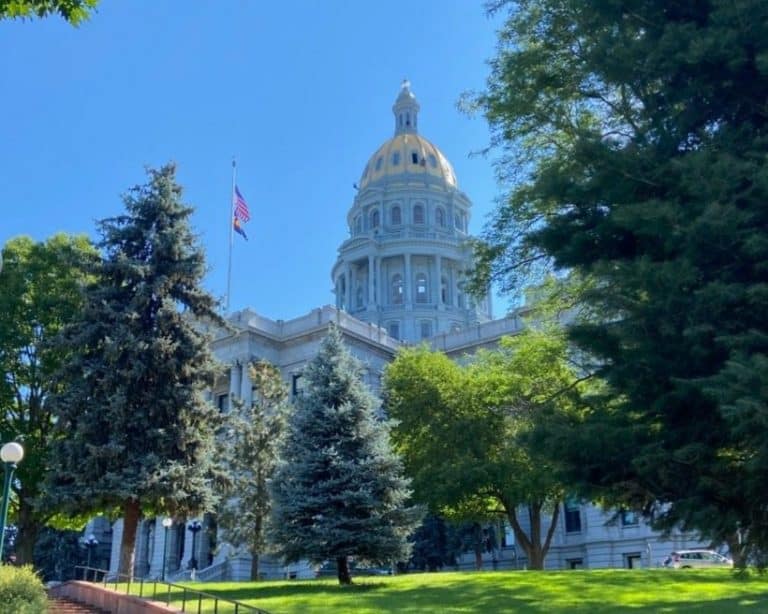
  • Playing “I Spy” at the Colorado State Capitol

    Visiting about a state’s history is one of our favorite activities and whenever we’re in a capital city, we make time to tour the state Capitol complex. The buildings are architecturally beautiful and the guides are usually enthusiastic, knowledgeable, and engaging. To date, we have toured capitol buildings in Massachusetts, Rhode Island (#5), New York, Pennsylvania, Virginia, and Arkansas (#6). On our summer 2021 road trip, we spent the day in Denver (we were in town primarily to see the Rockies) and made time for a tour of the Capitol.

    At one time, Denver was the second largest city in the West (behind San Francisco) and was part of the Gold Rush of the 1860s. Originally, what is now considered the state of Colorado was part of the Kansas, Nebraska, Utah, and New Mexico territories. In 1861 Colorado was declared a territory and became the 38th state in America. At first, Colorado City and then Golden were declared state capitals until 1867 when Denver became the permanent state capital. Construction on the Capitol building started in 1886, was completed enough for the building to be occupied in 1893, and then fully operational in the early 1900s. The building was designed on an axis in the form of a Corinthian Cross and closely resembles the design of the Capitol in Washington, D.C.

  • | | |

    10 Tips for Visiting Mount Rushmore National Memorial

    Known as the “Shrine of Democracy”, Mount Rushmore is located in the Black Hills region of South Dakota and attracts over two million visitors each year. The Black Hills are known for the ponderosa pine trees that give the illusion of darkness from a distance.

    The concept of an attraction that would drum up business for the economy and bring visitors to South Dakota was the idea of Doane Robinson, the state historian of South Dakota. He originally wanted to honor western heroes, like Lewis and Clarke and Chief Red Cliff. Robinson sought out mountain carvers and found well known sculpture Gutzon Borglum, who was working on a project in Georgia. Borglum changed the scope of the project by switching the location and the profiles to feature American presidents that best represent 150 years of American history. He chose Mount Rushmore, named for New York attorney Charles Rushmore who inspected the mountain for mining in the 1880s, because of its location: it was big enough for the scale of the project, it was made of hard rock, and it faced southeast, which provided good daytime light.