Five U.S. Travel Books Kids Will Love

| | |

Our children have always enjoyed reading and will spend hours a day reading, no matter where we are. Fortunately, they can read in the car and we often make a big Barnes and Noble order before a road trip. And while they mainly stick to fictional series, they do like to take a break for a puzzle or a game, or ask us trivia. 

This week, we’re sharing some of our favorite travel books. You’ll notice a common theme of the National Park system, one of our favorite destinations on any road trip. (You can read about some of the dozens of posts featuring National Parks and National Park service sites here). And be sure to check out the special giveaway at the bottom of the post.
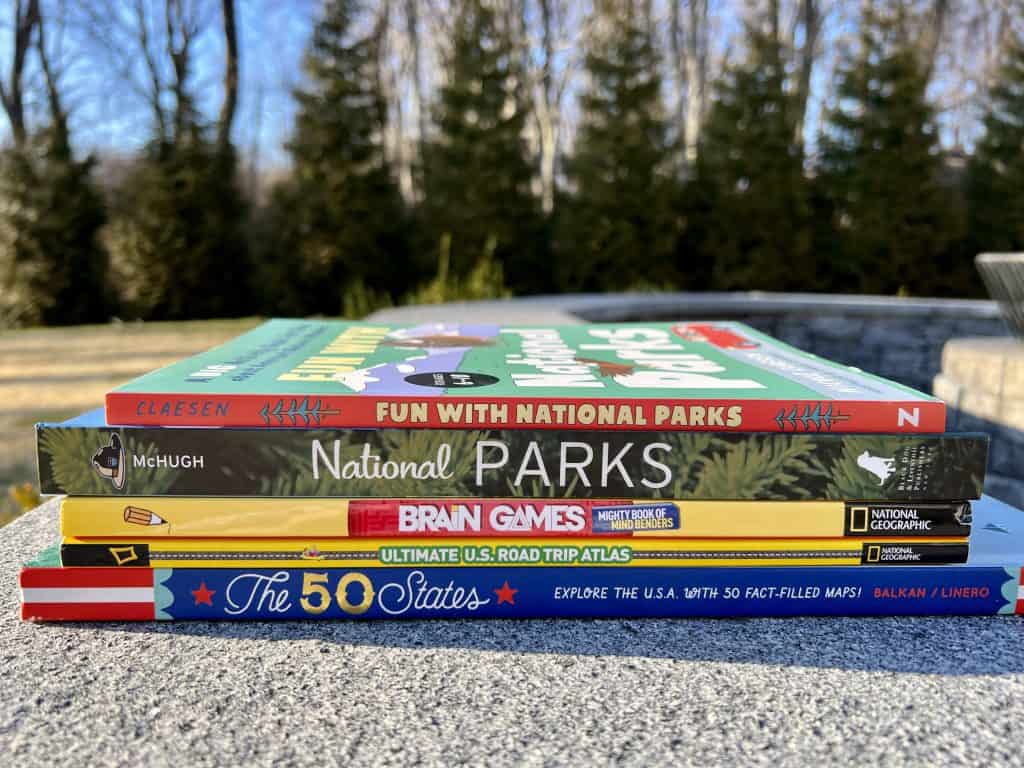
Five U.S. Travel Themed Books Kids Will Love:

  1. Fun with National Parks (Nicole Claesen, 2023) and National Parks: A Kid’s Guide to America’s Parks, Monuments, and Landmarks (Erin McHugh, 2012, updated 2019) both offer tons of information and trivia about America’s 63 National Parks. Fun with National Parks is an activity book; 150 pages filled with crossword puzzles, coloring pages, word searches, connect the dots drawings, and trivia quizzes. The book is organized by region and is perfect for kids 6-10, although I’ll confess I was challenged by more than one page! (There is an answer key in the index!) National Parks is also geared towards kids, but is organized by state and is more of a souvenir book. In addition to National Parks, the book includes historic parks, monuments, forests, and preserves. Each spot gets its own page with historical background, statistics, and cool ranger facts. Bonus: there is a cardboard inset for the “America the Beautiful Quarter Collection” on the back of the book.

Would you like to save this?

We'll email this post to you, so you can come back to it later.

  1. National Geographic’s Ultimate US Road Trip Atlas comes out with a new version every couple of years with revised stats and trivia. The book is organized alphabetically by state and includes a large map of the state, a “five cool things to do here” section, and unique roadside attractions (so many unique places we’ve never heard of!) Everyone will get a kick out of each state’s “traffic laws that you won’t believe!!” The back of the book includes scavenger hunts, trivia games, and I Spy picture searches. 
  2. National Geographic Kids Brain Games is a whole series with themes such as science and Masterminds. The book is organized with chapters that include memory challenges, word play, spatial games, and brain mysteries. We especially like that some of these challenges can be verbalized to the driver or other passengers to solve without having to look at the pages. 
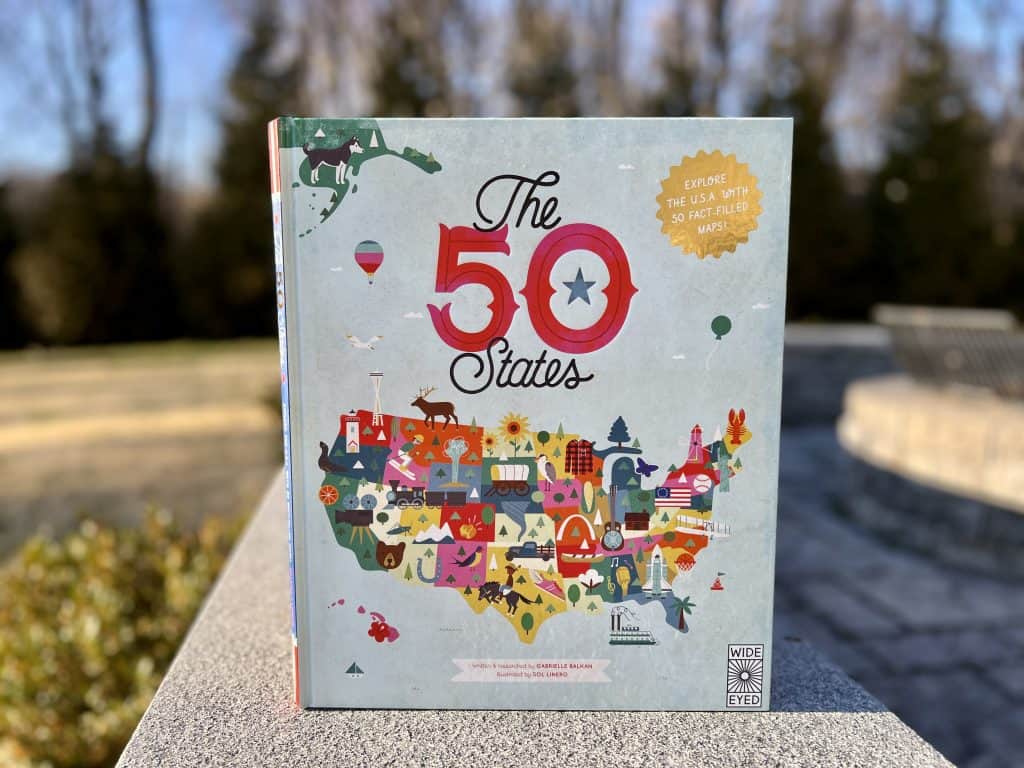
  1. The 50 States (Gabrielle Balkan, 2015) is a beautifully illustrated book, alphabetized by state. Each state includes a map with geographical highlights hand drawn. There are short bios of famous natives, as well as “Moments to Remember” and key trivia facts. The back of the book includes information on the presidents and a rendering of each state’s flag. Note: This book is significantly larger than most books. We tend to leave it under the seat, where it fits, and pull it out during a road trip. 
Bonuses: Of course, there is always the favorite word search, cross words puzzles, and Sudoku books to keep kids of all ages busy. 

We were gifted a copy of Fun with National Parks  by Nicole Claesen and would love to gift it forward to a family who loves National Parks as much as we do. To enter to win, please follow us on Instagram and Facebook and leave a comment on either post featuring the book. We’ll draw a winner from all the comments on April 3, 2023. Note we can only ship to the continental United States.

Disclosure:  We were gifted copies of Fun with National Parks and National Geographic Kids Brain Games. All opinions expressed are my own. 

Similar Posts

  • | | | | | | | | | | | |

    10 Reasons Why I Love the National Parks Service System

    Seven years ago I planned my first major road trip. My children were toddlers and we were planning on traveling almost cross country to visit good friends who were temporarily relocated to Albuquerque, New Mexico. Sharing my itinerary with my Uncle Bob, he asked if I planned on visiting any National Parks. I knew of the National Park Service system, but didn’t know much information about the various locations. Uncle Bob pulled out a worn, tattered, small blue spiral book and about an hour went by before I spoke again. (Full disclosure: Uncle Bob is a good storyteller and he does have a TON of travel experience.) His National Parks Passport book was filled with stamps dating back to the early 1970s. It was the perfect memento of his travels and I knew I had to start my own passport book.

    Since 2012, I have collected dozens of passport stamps from various stops in the National Park Service system. There are over 400 locations in the United States and American owned islands. These locations include parks, monuments, battlefields, historic sites, lakeshores, seashores, recreation areas, scenic rivers and trails, and even the White House. With every stop, I became a bigger and bigger fan of the National Parks system. Here are my top 10 reasons why:

  • | | |

    Sandoway Discovery Center in Delray Beach, FLA

    Opened in 1998 in a former private residence in downtown Delray Beach, Florida, Sandoway Discovery Center is a nonprofit center focused on the native coastal environment and its inhabitants. The Center, which is on the National Register of Historic Places, has plans to expand the outdoor area with an additional touch tank for stingrays in the coming year.

  • | | | | |

    National Park Guide: Arches National Park in Utah

    Arches National Park in Moab, Utah, one of the most popular National Parks in America with two million visitors each year, is home to over 2,000 cataloged arches formed by erosion and weathering over the past 65 million years. Learn more about how the arches were formed here. Today, the park covers over 76, 000 acres and, in addition to the arches, is home to almost 500 species of plants, almost 200 species of birds, 50 species of mammals, 21 species of reptiles, and 6 species of fish (yes- fish!)

    We visited in June of 2021, during the still on going COVID pandemic, and there were some restrictions, mainly with the Visitor’s Center and programs. We highly recommend visiting early in the morning (being inside the park by 6am early), spending the morning hiking, and then leaving the park for lunch and a rest during peak afternoon sun. Later afternoon and evening will provide cooler temperatures and smaller crowds. Be careful to stay away from cactus and yucca plants, both of which are prevalent throughout the park. Both plants have sharp tips that can poke and easily puncture skin.

  • | | | | |

    Stamford Museum & Nature Center in Connecticut

    The Stamford Museum and Nature Center in Stamford, Connecticut is practically in my backyard and yet it’s taken me almost 12 years to visit! We’ve felt most comfortable visiting outdoor locations due to the COVID 19 pandemics, so this seemed like the perfect time to explore the farm and nature center.

    There are over 80 acres of gardens, trails, and buildings spread out across the complex. Visitors are welcome to visit with animals, smell the fruits and vegetables in the garden, check out the playground, explore the mansion, and hike and walk some of the trails.

  • | |

    Six Tips For Booking the Perfect Hotel

    I was recently talking with a friend who is booking a series of hotels for an upcoming road trip. We discussed some of the factors that help us pick “the perfect spot” and the conversation inspired me to share my tips with you. 

    This week, I am sharing six factors I always take into consideration when choosing a hotel. I’ll share a disclosure that we are partial to Marriott Hotel and have written about them in the past. But these tips are relevant for any hotel or lodging option:

  • | | |

    Playing “I Spy” at the Vermont State Capitol

    Vermont, the 14th state in the union, chose Montpelier as the state capital because of its central location and accessibility to the nearby Winooski River. The first State House, a traditional wooden meetinghouse, was open from 1808-1835, and then moved and expanded to a nearby, larger space from 1836-1856, until a fire destroyed most of the State House in January of 1857. The third, and current, State House was completed in 1859, built in an Italian Renaissance revival style, with all features made from masonry and cast iron; only the dome (57 feet high and covered in gold leaf) is made of wood. (Even the doors and staircase railing were painted to look like mahogany!)

    The Vermont Senate Chamber, which has 30 members, is the oldest senate chamber in America that is still actively used and still has all of the original furniture and lighting from 1859 (except for two filing cabinets and a computer). The 150 member House Chamber is the largest room in the State House. Vermont legislators have no private offices at the State House; they conduct business at their chamber desks or in groups in large committee rooms on the first floor. And unlike most state Capitols, there is no rotunda inside the Vermont State House, the dome is an exterior ornament. 

    Hubbard Park, located behind the State House, is home to walking trails, a fitness trail, an interpretive trail, a 54 foot stone tower, and picnic shelters. The State House complex welcomes visitors all year and encourages exploration of its grounds.

7 Comments

  1. I love these books and would like to read them myself. Great ideas and lots f fun for the kids. Maybe I can borrow one? 🙂

  2. I remember when my two were little, and we would load up travel books relating to our destination for them to read on the go. These are a fab selection to inspire an interest in reading and travel.

Leave a Reply

Your email address will not be published. Required fields are marked *