Exploring Flume Gorge in Lincoln, New Hampshire

| | |

On a recent weekend in New Hampshire, we decided to explore a few state park sites: Lost River Gorge and Caves in and nearby Flume Gorge in Lincoln, inside Franconia Notch State Park.

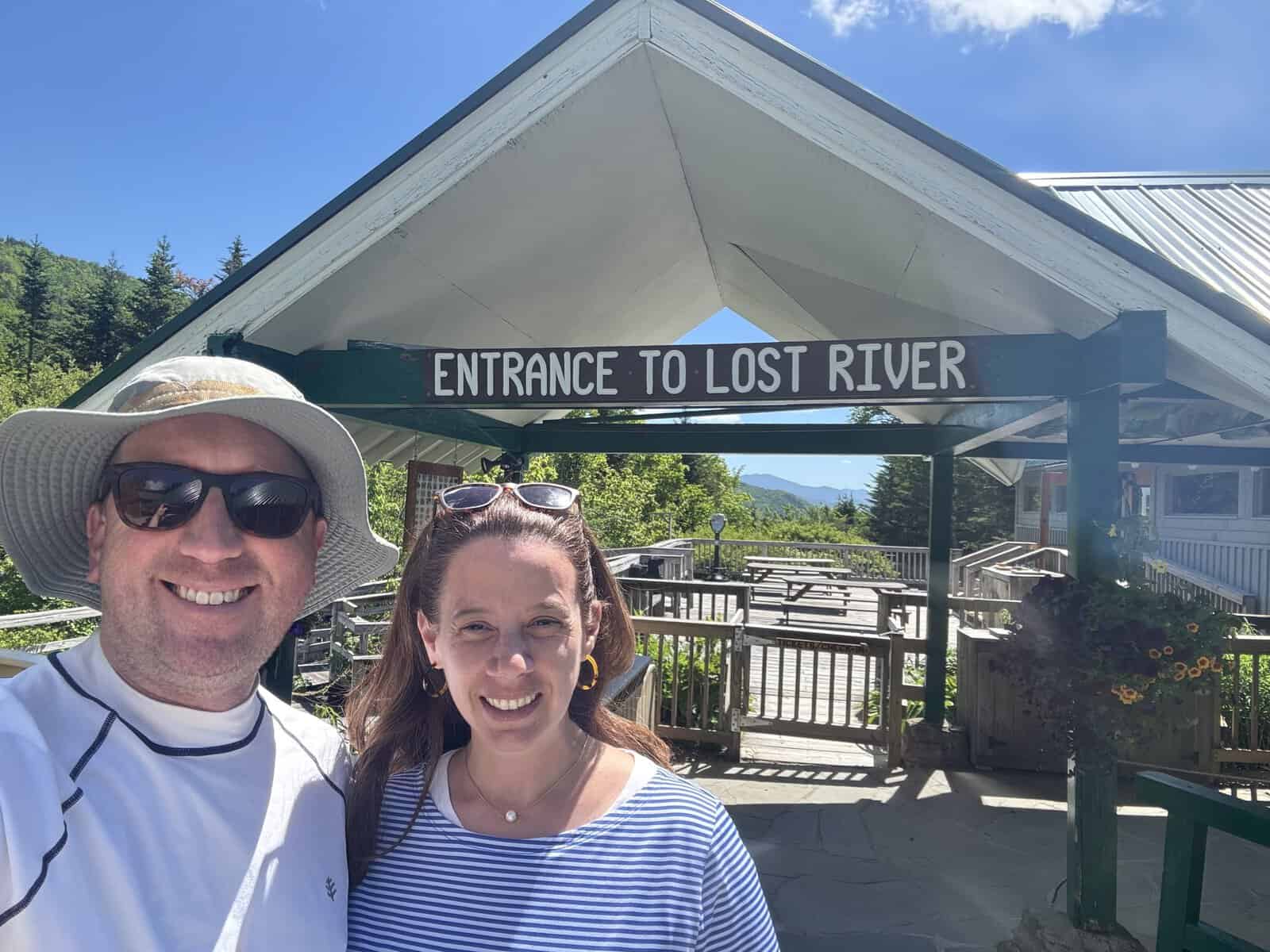
man and women outside The Flume sign of the Visitor center of the Flume Gorge in Lincoln, NH

According to the placards along the trail, The Flume Gorge was created over 200 million years ago during the Jurassic Age when the granite in the area was buried by molten rock that broke when cooled. Dark rocks called basalts pushed the granite to form various shapes and valleys. Later, during the Ice Age, the gorge was covered by ice sheets and then filled with glacier debris.

Today, the gorge is 800 feet long and up to 20 feet wide at certain points. There are several other highlights and points of interest throughout the two mile trail that visitors will enjoy. The trail is not strenuous and the boardwalk is well marked and easy to follow, but there are a lot of stairs to get to the top of the gorge. There are benches throughout the trail and a couple of wider platforms between staircases to stop and rest, and look carefully at the moss, flowers, and trees growing in and around the rocks. Make sure to pick up a map when checking in with park rangers. 

posing on the trail at the Flume Gorge in Lincoln, NH

Travel Tips:

  • Flume Gorge is open from early May through late October, usually from 9am-4pm. Check here for up to date information on hours and admissions fee. Purchase tickets online ahead of time to save money and guarantee admission. The public entrance to the trail is located to the left of the Visitor Center.
  • Plenty of free parking in front of the Visitor Center.
  • Restrooms, a gift shop, a cafe and park rangers available inside the Visitor Center from 9am-4pm each day. Note: there are also bathrooms inside the Boulder Cabin.
  • Wear sturdy sneakers and consider dressing in layers and bringing a raincoat. Strollers are not allowed on the trail.
  • No other dining facilities besides the cafe, on site. Picnicking allowed only near the Visitor Center
  • Plan on 90 minutes to walk the full, two mile trail. See the trail map here and be sure to stay on the designated trail.
  • We recommend following the trail counter clockwise (head right when the trail splits in the beginning) and see the flume first.

Would you like to save this?

We'll email this post to you, so you can come back to it later.

10 Highlights of Exploring Flume Gorge

  1. The Visitor Center: A great spot to get trail maps and other information and recommendations from park rangers, grab a quick bite to eat, use the restrooms, and fill up water bottles. There is also a short film in the auditorium that 
  2. The Great Boulder: A 300 ton boulder at the intersection of the trail, one of the largest in the park. 
  3. The Flume Covered Bridge: Built in 1886, it is one of the oldest covered bridges in New Hampshire, bringing visitors safely over the Pemigewaaset River, which means “rapidly moving” in the Abenaki language.
  4. The Table Rock: Made of Conway granite, the rock is 500 feet long and 75 feet wide and quite slippery! Note: Do not try to sit on the rock.
  5. Boulder Cabin: With exhibits filled with photographs, old maps, and memorabilia of hikers and park rangers from the last century and older. Note: there are restrooms inside the cabin.
standing in front of Glacier Boulder at the Flume Gorge in Lincoln, NH
  1. The Flume Gorge: Climb steps on man made wooden boardwalks to the top of the 800 foot gorge at the base of Mount Liberty. The surrounding granite can be as tall as 900 feet in some areas! At the top of the flume, peek over the ledge (carefully!) and see the 45 foot waterfall named Avalanche Falls, formed during a 1883 storm that transformed much of the area. 
  2. Liberty Gorge: A beautiful stream of water that flows down the mountain, just off the Ridge Path.
  3. The Pool: From the designated viewing area further down the trail, look down below to the 40 foot deep basin that is often replenished with water flowing down from the surrounding cliffs.  Note: swimming is not allowed in the “pool”.
  4. Sentinel Pine Covered Bridge: Made from the wood of one of the largest, and oldest, sentinel pine trees in New Hampshire. There are also great views of the Pool from the bridge. 
  5. The Wolf Den: Crawl through a one way path through boulders. 

Note: There are a few rain shelters throughout the trail to take cover if the weather turns dangerous while out on the trail.

rain shelter at the Flume Gorge in Lincoln, NH

For other nearby adventures, check out this map of attractions and this map of hiking spots inside Franconia Notch State Park. And check out our other adventures at nearby Lost River Gorge and Caverns, StoryLand (about an hour away), Concord (about an hour south), and Portsmouth (about two hours away).

Similar Posts

  • | | | |

    National Park Guide: Capitol Reef National Park in Utah

    Capitol Reef National Park, located in Surrey, Utah, opened as a National Monument in 1937 and officially became a National Park in 1971. The entire state of Utah was once a sand dune (200 million years ago) and overtime, various geological feats created the park. The geology of the park is quite complex (attend a ranger talk to learn more!), but the headline involves various rock layers that, through tectonic plate activity, raised the Colorado Rocky Mountains and Colorado Plateau, which caused a fault line running through the area to develop into the park. Over time, the western part of the park raised over 7,000 feet higher than the eastern part of the park. Today, the Visitor Center sits 5,500 feet above sea level.

  • | | |

    15 Ways to Explore the Crane Estate on Castle Hill in Ipswich, Massachusetts

    On a recent visit to the North Shore of Massachusetts, we explored one of the most beautiful Gilded Age estates, the Crane Estate, set high on a hill above one of the most beautiful beaches, Crane Beach, in Ipswich, Massachusetts. The estate has been carefully restored and preserved by the Trustees, who oversee more than 100 properties throughout Massachusetts. 

    The Crane Company, founded by Richard Teller Crane, in 1855 was well known for their brass fixtures and bells, most famously used to help build the Golden Gate Bridge in San Francisco.  Later, his son, Mr. Richard T. Crane, who focused the company on manufacturing various bathroom fixtures, purchased Castle Hill and began renovating and expanding the property. The Cranes, who were based in Chicago, had summer homes in London, England and Jekyll Island, Georgia. The first home on the Ipswich property was built in 1912 but later torn down as it was properly outfitted to withstand the elements of the nearby ocean. The current estate, with 59 rooms, was built in a timeless English style similar to the Cranes’ London estate and finished in 1929. Over the years, the Cranes restored over 3,500 acres in Essex Bay, Choate Island, and Ipswich. The estate also includes the 700 acre Crane Wildlife Refuge, made up of Castle Neck (which borders Crane Beach), five islands, and salt marshes.

  • | | | |

    10 Ways to Explore the McAuliffe Shepard Discovery Center in Concord, N.H.

    The McAuliffe Shepard Discovery Center in Concord, New Hampshire is a science museum and planetarium that honors the life’s work and legacy of the first American in space and Derry, New Hampshire native, Alan Shepard, and Concord High School social studies teacher and the first teacher in space, Christa McAuliffe. Opened as a stand alone planetarium and memorial to Christa McAuliffe in 1990, the center added Alan Shepard to its honorees, and then expanded to include a full science museum in 2009. The  45,000 square foot center one of the most popular attractions in the capital city of Concord, New Hampshire, just hour north of Boston. There are dozens of interactive STEM exhibits that will engage the whole family. 

  • | | | |

    Exploring Lost River Gorge and Boulder Caves in New Hampshire

    Ever since our love of National Parks began over a decade ago, we have started to enjoy hiking a little bit more, especially anytime hiking involves exploring water features like waterfalls and lakes. So, when I recently heard about Lost River Gorge and Boulder Caves in the White Mountains of New Hampshire and saw its close proximity to a family event we were attending, I knew we had to stop and explore the area.

  • | | | | | | |

    Acadia National Park, Maine

    I may not be a huge hiker or camper, but I am a huge fan of the water, especially the ocean water, and love any view that involves water or mountains. I’m also a HUGE fan of the National Parks Service system and have been visiting historic sites, monuments, museums, and parks for years, learning all about our country’s history and collecting stamps for my National Parks Passport. So, it seemed logical to put Acadia National Park in Maine on my bucket list. This summer, I helped to plan a family reunion in York, Maine (post coming next week) and I seized the location and added a visit to Acadia National Park.

    Acadia National park is a 47,000 acre park (the only National Park located in New England) It’s located on Mount Desert Island, right next to the beautiful village of Bar Harbor. Acadia is unique in the sense that there is no one, defined entrance and exit site. There are multiple spots to enter and the park weaves in and out of the community. There are sections that require a park pass, which for 2017, was a $25 fee for a week pass for a noncommercial vehicle. Lucky for us, the Every Kid in a Park program allows fourth graders, and their families, to receive entrance to all National Parks all year long, so we got in for free! There is SO much to do in Acadia, it would take days to cover it all. Here are some of my family’s top spots:

  • | |

    10 Family Friendly Hiking Spots in Fairfield County, Connecticut

    We’re back with another index of places we’ve explored in the past year. (We’ve previously posted about places to hike in Western Connecticut and places to hike in the Mystic area.) Many of these spots are practically in our backyard and it’s taken us an embarrassingly long time to check them out. They are all free to visit in the off season (October-May), although some locations do rely on donations for upkeep and programming. Most of the locations in this collection are somewhat of a stretch for “hiking” for true hikers, as many of the trails are under three miles and fairly easy to navigate. But we think they’re all great spots for family fun, especially families with younger kids.

One Comment

Leave a Reply

Your email address will not be published. Required fields are marked *