Saratoga National Historical Park in Stillwater NY

| | | |

This post begins a week long series about my family’s trip to Saratoga Springs, New York.

Most people probably recognize Saratoga Springs as the center of the horse racing world. Indeed, the horses take to the track every July, August, and September. Checking out the races was the catalyst for planning a recent trip to the area. However, while researching, I quickly discovered there is a lot more to do than just go to the race track; so much to do that we couldn’t cover it all in one trip. Each day, I’ll share some personal highlights from our adventures.  

Whenever I plan a trip, one of my first points of research is to check my National Parks map to see if any spots are located on our route.  Sure enough, driving to Saratoga Racetrack we passed Saratoga National Historical Park, with five different stops. It was a rainy, dreary morning so we could not take full advantage of the park, but we still learned a lot about the Revolutionary War:
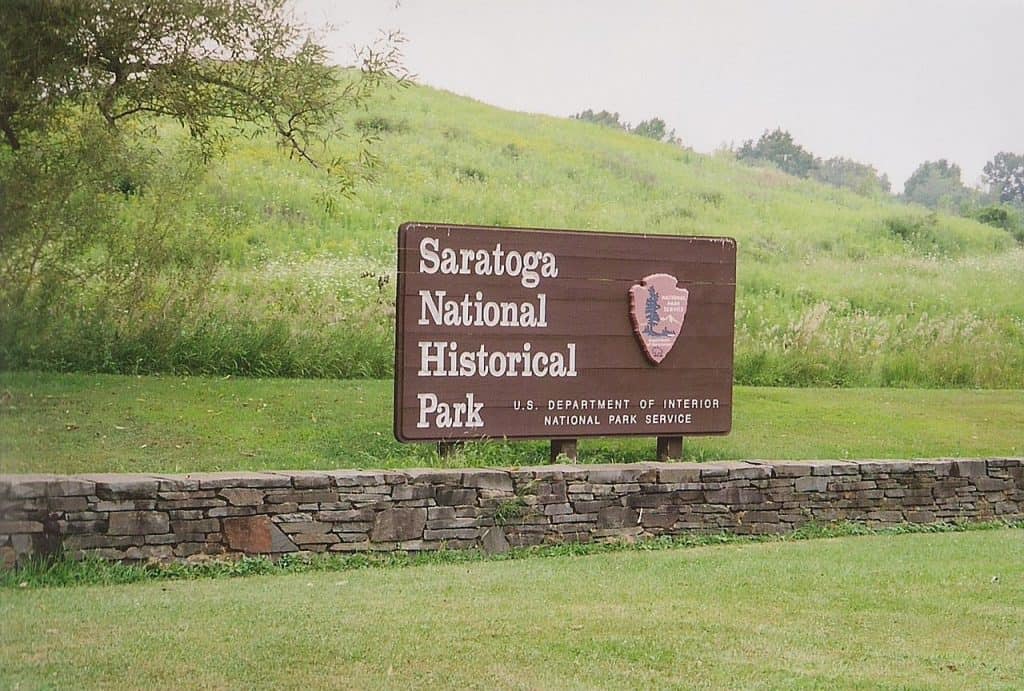
Saratoga Battlefield Visitor Center: The grounds are beautiful and would have been fun to explore had it not been raining hard when we visited. We opted to spend an hour inside learning about the two battles in the fall of 1777, during the Revolutionary War. Those battle are considered the turning point of the war because they were the first times that a British army surrendered to the United States. See if you children can “I Spy”:

  • A tent to reenact sleeping on the battlefield (little ones will love “hiding” from their parents)
  • A costume area to dress up as either an American or British soldier
  • A huge chalkboard to keep children entertained while adults read more about the battles
  • A pair of silver cufflinks belonging to General John Burgoyne (my daughter loves anything flashy and sparkly)
  • Weapons of War: a big display of authentic muskets, cannonballs, pistols, and spoontoons.
  • A twenty minute film that explains the history of the battles, including film footage shot right on site in 2002.

Would you like to save this?

We'll email this post to you, so you can come back to it later.

Don’t forget to collect four stamps for your passport at the Visitor’s Center.

Saratoga Tour Road: You can drive the 10 mile paved driving tour road that goes through the camp and battle locations.

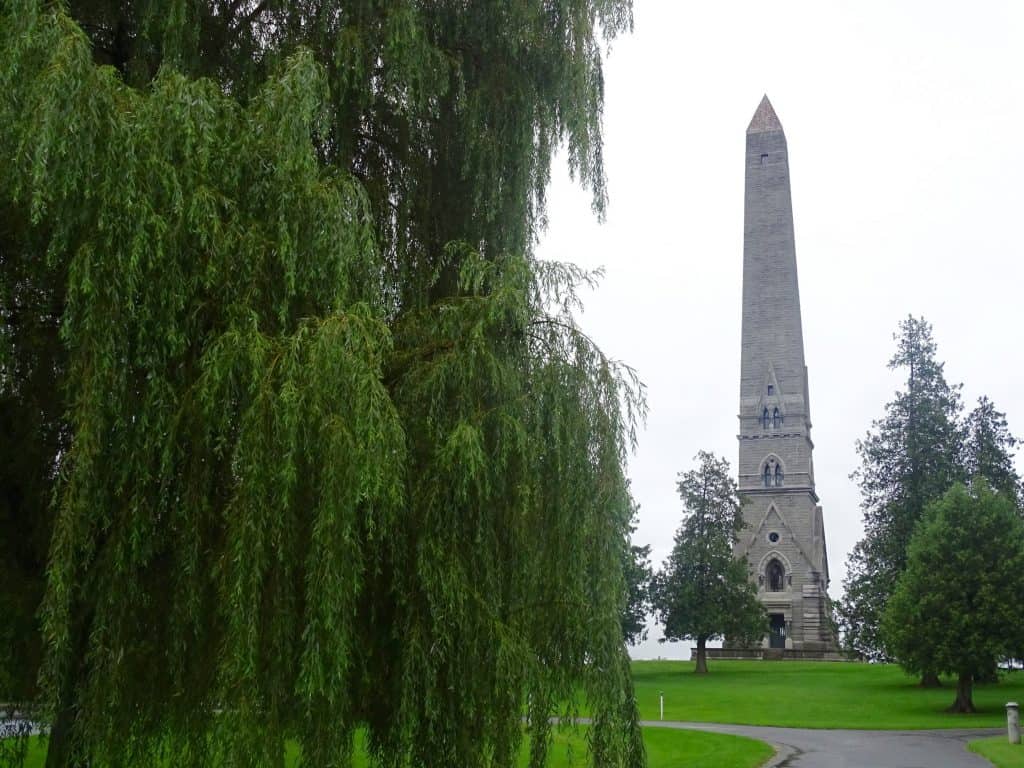
Saratoga Monument: It’s only open on the weekend (we were passing through on a Tuesday) so we could not climb the 188 steps to the top of the 155 foot granite monument. However, it looked like a beautiful property with a hill kids where could burn a lot of energy and spots to picnic. It’s a short, five minute drive from the battlefield, in the middle of a residential neighborhood. As we were driving through town, we also passed Schuyler Corn Maze and Farm which looked like it would be a lot of fun come fall.
Victory Woods: A four mile hiking trail that goes through most of the sites where the battles occurred. You can park at the monument parking lot and follow the white trail markers on the dirt road by the cemetery.

Schulyer House: The restored home of American General Schuyler, dating back to 1777. It’s about a mile from the monument  and again, only open on the weekend, so we could not explore it ourselves.

A quick glance at their 2017 calendar shows a variety of activities from Frost Faires in the winter to Junior Ranger days in the spring to evening bike tours and music series in the summer to candlelit tours in the fall. I wished we lived closer! 

Similar Posts

  • | | | | |

    Yankee Candle Village in South Deerfield, Massachusetts

    I’ve been obsessed with Yankee Candles for a long time. Anyone who knows me would probably say I have the most sensitive nose they have seen. It’s true: I need my environment to smell good. So whether it’s fall (Macintosh or Spiced Pumpkin), the holiday season (Christmas Cookies or Homes for the Holidays), or summer (Blueberry or Lush Berries), I always have a Yankee Candle burning in my home (and yes, I have the car jar fresheners for my car- French Vanilla is my favorite).

    I made a brief stop at the Yankee Candle Village in South Deerfield, Massachusetts years ago (I had a shortage of Macintosh and fall was approaching, if I remember correctly) but could not stay to explore the village. So, it went on my travel list, and this past week my family had the opportunity to visit.

    The Massachusetts Yankee Candle Village (there is also a location in Williamsburg, Virginia) is located thirty minutes north of Springfield.  The campus opened in 1982 with a 5,000 square foot building; now there’s over 90,000 square feet of fun to explore. The village welcomed over 500,000 visitors from over 50 countries in 2017, and many of them made a visit during the popular fall foliage and holiday season time.

  • | | | | |

    National Baseball Hall of Fame & Museum

    The major impetus for the road trips my family has become known for is our love of baseball. To date, we’ve seen 22 of the 30 Major League baseball parks and we’re on track to visit two more in 2018. We love baseball. So when we planned a trip to visit friends near Utica, New York we decided to make a short detour to visit the village of Cooperstown, New York, home of the National Baseball Hall of Fame and Museum. Independently owned, the National Baseball Hall of Fame elected its first class in 1936 and the original Hall of Fame (which sits on the property of the current museum) opened in 1939. It was built in Cooperstown because of a now debunked theory that Abner Doubelday invented the sport in Cooperstown in 1839.

    The museum is quite popular, welcoming about 275,000 visitors each year; on a typical summer day, the museum sees over 2,000 visitors. Many nearby attractions are only open in season (in April-May and September-October with limited hours, and full time June-August), which would make a summer visit appealing. However, if you really want to linger and get up close to every display and plaque in the Hall of Fame (and still have lots of lodging and restaurant choices), come in the quiet off season. I imagine mid and late October would be especially beautiful with the foliage.

  • | |

    10 Family Friendly Hiking Spots in Fairfield County, Connecticut

    We’re back with another index of places we’ve explored in the past year. (We’ve previously posted about places to hike in Western Connecticut and places to hike in the Mystic area.) Many of these spots are practically in our backyard and it’s taken us an embarrassingly long time to check them out. They are all free to visit in the off season (October-May), although some locations do rely on donations for upkeep and programming. Most of the locations in this collection are somewhat of a stretch for “hiking” for true hikers, as many of the trails are under three miles and fairly easy to navigate. But we think they’re all great spots for family fun, especially families with younger kids.

  • | | |

    Playing “I Spy” at the Flagler Museum on Palm Beach Island, Florida

    We recently spent time exploring St. Augustine Florida, a city that Henry Flagler basically built after the start of his 1912 Florida East Coast Railway and subsequent hotels, hospitals, schools, churches, and farms. (Read more about our adventures in St. Augustine in these posts. So, it was fitting when we also traveled to the West Palm Beach area of Florida in the same trip, we spent the morning at Flagler’s “winter cottage”

    Henry Flagler was successful in the grain and salt mining industries before he helped to found the Standard Oil Company with John D. Rockefeller and Samuel Andrews in 1867.  When he married his third wife, Mary Lily Flager, in August 1901, he promised her a “waterfront winter cottage” and had “Whitehall”, as it was named, built in a record 18 months. The Flaglers spent approximately two months there each year until Flagler’s death in 1913. 

  • | | | |

    10 Tips for Visiting Wind Cave National Park in South Dakota

    The 28,295 acres of Wind Cave National Park in the Black Hills of South Dakota are home to the 7th longest cave in the world, and the 3rd longest cave in America. The cave was discovered by Jesse and Tom Bingham in the early 1880s and 21 Native American tribes associated with the Wind Cave. President Theodore Roosevelt established Wind Cave as the 8th National Park in 1903, naming it after the barometric winds at the entrance to the cave. There are 156.3 miles of passageways in Wind Cave and 95% of the world’s boxwork hangs inside the cave, along with 12 species of bats (although we didn’t see any on our visit).

    We spent a summer morning on 4th of July weekend exploring the park and taking a Natural Entrance Cave tour and loved it! The park is fairly isolated, with no dining options, so plan ahead and bring food. Here are our 10 tips if you’re planning a visit to Wind Cave National Park.

  • | | | | | | | | |

    City Guide: 25 Places in Manhattan Kids Will Love

    We are fortunate to live an hour outside of New York City and we take advantage of our close proximity as much as possible. There are so many family friendly places in the 22 square miles of New York City that our list could potentially go into the hundreds! For this week, however, we’ll stick with 25 places we have explored over the past decade, including a few spots that spill over into the Bronx. 

    We’ll acknowledge some gaps in this list- the Metropolitan Museum of Art and American Museum of Natural History are missing from this list- but we have not been to some very popular spots in over a decade (all the more reason to rerun ASAP!) For organizational purposes, we’ve listed sites by location, starting with the Financial District and working on our way up island through the Upper East and West Sides all the way to the Bronx (we had to include a couple of our favorite spots, which happen to in the Bronx- see #23-25)