Playing “I Spy” at the Walt Whitman Birthplace State Historic Site on Long Island, New York

| |

The Walt Whitman Birthplace and State National Historic Site in Huntington on Long Island, New York is the former home of the Whitman family, including one of America’s greatest poets, Walt Whitman, who was born in the first floor bedroom in 1819. 

entrance to the Walt Whitman Birthplace State Historic State on Long Island in New York

Walt’s father, Walt Sr., built the two story farmhouse, originally on 68 acres of farmland, in the early 1800s for a wealthy family. By 1816, the family had lost their wealth and the house went into foreclosure. Walt’s dad gathered enough money to purchase the estate for his family. Walt and his three siblings were all born on the property in the late 1810s and early 1820s and the family worked to make the farm a success. However, by 1823, Walt Sr. decided to sell the property and moved the family to Brooklyn, New York.

Several families lived on the farm throughout the 19th and early 20th century. In the 1940s, the community, organized by the Huntington Historical Society, wanted to preserve the property and created the Walt Whitman Birthplace Association in 1951. In 1957 the site became New York’s 22nd state historic site and opened to the public. Today visitors are welcome to explore the 1.5 acres property which includes the Interpretive Center and main house and learn all about the life and works of one of America’s most influential poets.

portrait of Walt Whitman outside at the Walt Whitman Birthplace State Historic State on Long Island in New York

Travel Tips:

  • The site is open seven days a week from 11am-4pm from mid June through Labor Day and Wednesday through Sunday during the school year with varying hours; check here for up to date information on hours and admission fees.
  • Use Old Walt Whitman Road as the GPS address (the property is located behind the commercial Route 110). There is a small parking lot in front of the entrance, accessible from Old Walt Whitman Road. 
  • No dining options on site, but plenty of options on nearby Route 110 and Walt Whitman Shops (a Simon Mall) 
  • Restrooms and a small gift shop are located inside the Interpretive Center
  • The Interpretive Center and the first floor of the main house are handicap accessible; the second floor of the house is not handicap accessible, but there is an online virtual tour
  • The site offers several family friendly programs and special events see the full calendar here.
  • Plan on 45 minutes to explore the Interpretive Center and grounds and another 30-40 minutes for a tour of the house
photo collage of Walt Whitman at the Walt Whitman Birthplace State Historic State on Long Island in New York
gift shop at the Walt Whitman Birthplace State Historic State on Long Island in New York

Playing “I Spy” while touring the main house:

  • Look for signs of wealth like the numerous windows (expensive and not necessary for a “farmhouse”), the interior blue paint color (which was considered an expensive color for the time), and two doors in every room
  • Swinging handle for the pots in the fireplace of the South Parlor (used on weekends for socializing)
  • Cupboard the South Parlor, which showed off the carpentry skills of Walt’s dad and also indicated that the family had enough clothes to fill the shelves.
  • The length of the cradle in the North Parlor Room, known as the Birth Room.
  • Chamber pots under the beds in the second floor Guest Room
  • Toddler training chamber pot in the Main Bedroom-the whole family stayed in the main bedroom when the kids were out of the newborn stage.
  • Original chair from the house in the Grandmother’s Bedroom and the bed warmer used under the bed
  • The original beams and nails in Attic Room
  • The narrow dining table in the kitchen (the family never lingered over food) and the yoke, which women wore on their shoulders to help them carry heavy water
  • Long spoon hanging in the kitchen, which women used to protect their long dresses from the fires
  • Candle making materials in the kitchen (they used the animal fat drippings from the meat as the base for the candles) to make candles and not waste anything.
  • Water buckets, made from leather, by the front door, in case a fire got out of hand and threatened the house

Would you like to save this?
We'll email this post to you, so you can come back to it later.

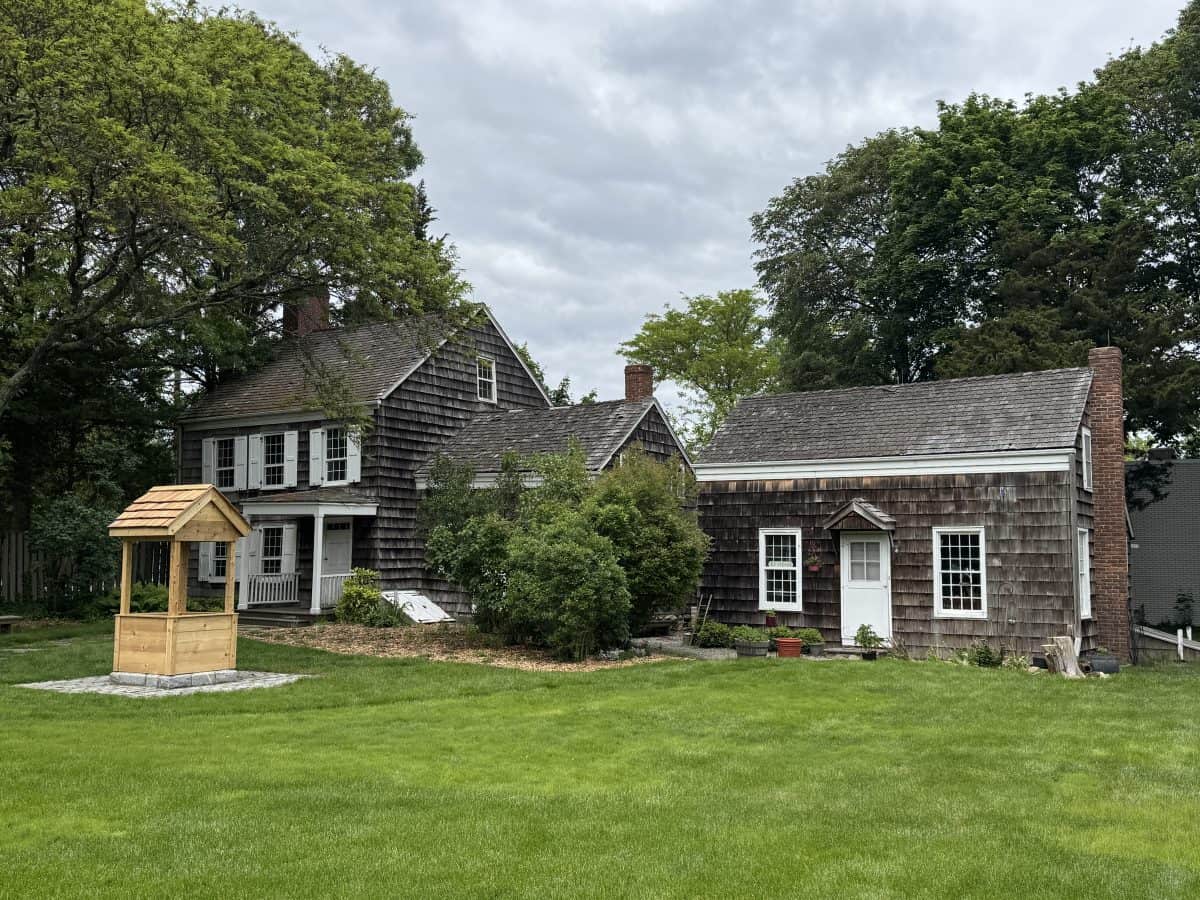
main house at the Walt Whitman Birthplace State Historic State on Long Island in New York

Other Places to Explore on the Property:

  1. The Interpretive Center, opened in 1997, has an exhibit featuring timeline of Whitman’s life (highlighting his founding of the The Long-Islander newspaper, multiple editions of Leaves of Grass, his experiences in Washington DC supporting soldiers during the Civil Wars and the two debilitating strokes he endured in 1873 and 1888) and copies of his writing, including a first edition of Leaves of Grass. There are also dozens of portraits of Whitman, one of the most photographs poets of all time. The space is also used for lectures and special events and programs.
  2. The Care Taker’s Residence to the right of the house, built in the 1950s to protect looters or curious visitors from taking things from the property or harming it. Today, a caretaker still lives on the property at night and on weekends and oversees the property.
  3. The Gathering House Barn, mainly used for school programs and small group workshops
  4. The grounds and gardens: Peek down into the well, which was just replaced on the site of the original well. See a life size bronze statue of Whitman made by Jo Davidson (other castings of the statue are on display at Bear Mountain State Park in New York and at the entrance to the Walt Whitman Bridge, connecting Pennsylvania and New Jersey). Check out the various gardens, which include medicinal plants and flower gardens.
quote on building outside the Interpretive Center at  the Walt Whitman Birthplace State Historic State on Long Island in New York

Gathering Barn the Walt Whitman Birthplace State Historic State on Long Island in New York

Looking for other adventures on Long Island? Check out our feature of Planting Fields Arboretum, the Long Island Aquarium, the Suffolk County Vanderbilt Museum and Planetarium, our feature of Eagle’s Nest inside the Vanderbilt Museum and Planetarium, and our full City Guide to Sag Harbor.

Disclosure: Our family was given a media pass to explore the site; all opinions expressed are my own.

Similar Posts

  • | | | | |

    Mount Vernon in Virginia

    Mount Vernon, home to George and Martha Washington and their family, is the most popular home in America- over one million people visit each year. The home, located twenty minutes outside downtown Washington DC in Mount Vernon, Virginia, was originally a 8,000 complex with five farms: Dogue Run, Muddy Hole, River, Union, and Mansion House Farms. Washington also built a gristmill and distillery on the property, which is on the banks of the Potomac River, with Maryland on the other side of the river.  Washington took possession of the home in 1739 and completed a major renovation by 1787.  After George and Martha died in 1779 and 1802 respectively, the home was passed on to family until 1860, when the home was open to the public.  The now 50 acre site includes over two dozen areas to explore. We’ve included ten spots children will most enjoy.

  • | | | | | |

    Boone Plantation, South Carolina

    The South is known for numerous plantations: large estates with farms producing a wide variety of crops. One of the most popular and still functioning plantations is the Boone Hall Plantation in Mount Pleasant in South Carolina.  Located just 20 minutes outside of historic Charleston, Boone Hall was founded in 1681 on the banks of the Wampacheone Creek by English Major John Boone. For centuries the plantation was known for growing and selling cotton and pecans. Now, the Boone Hall Farms Market also sells various fruits, vegetables, seafood (from the local docks), prepared foods, and gifts. Film buffs will recognize the estate from the film “The Notebook.”

    The plantation offers a wide variety of ways to explore the site and learn from history. All tours are included with the admission fee. I first wrote about Boone Plantation for Kidventurous, but wanted to share some of my favorite parts of our visit and a few nearby bonus stops: (updated for summer 2017) 

  • | | | | |

    National Baseball Hall of Fame & Museum

    The major impetus for the road trips my family has become known for is our love of baseball. To date, we’ve seen 22 of the 30 Major League baseball parks and we’re on track to visit two more in 2018. We love baseball. So when we planned a trip to visit friends near Utica, New York we decided to make a short detour to visit the village of Cooperstown, New York, home of the National Baseball Hall of Fame and Museum. Independently owned, the National Baseball Hall of Fame elected its first class in 1936 and the original Hall of Fame (which sits on the property of the current museum) opened in 1939. It was built in Cooperstown because of a now debunked theory that Abner Doubelday invented the sport in Cooperstown in 1839.

    The museum is quite popular, welcoming about 275,000 visitors each year; on a typical summer day, the museum sees over 2,000 visitors. Many nearby attractions are only open in season (in April-May and September-October with limited hours, and full time June-August), which would make a summer visit appealing. However, if you really want to linger and get up close to every display and plaque in the Hall of Fame (and still have lots of lodging and restaurant choices), come in the quiet off season. I imagine mid and late October would be especially beautiful with the foliage.

  • 10 Stops on the Ultimate Tour of Acrisure Stadium in Pittsburgh, Pennsylvania

    This week we’re celebrating the start of football season by sharing our tour of Acrisure Stadium, home of the Pittsburgh Steelers and UPitt Panthers. On a recent trip to Pittsburgh, Pennsylvania, we had the opportunity to tour the 68,000 seat stadium and many popular areas of the stadium, as well as a few spots the typical ticket holder doesn’t get to see.  The tour is fun and engaging and everyone (even us Giants fans!) will have a good time.

  • | |

    Six Tips For Booking the Perfect Hotel

    I was recently talking with a friend who is booking a series of hotels for an upcoming road trip. We discussed some of the factors that help us pick “the perfect spot” and the conversation inspired me to share my tips with you. 

    This week, I am sharing six factors I always take into consideration when choosing a hotel. I’ll share a disclosure that we are partial to Marriott Hotel and have written about them in the past. But these tips are relevant for any hotel or lodging option:

  • | | | | | | | |

    City Guide: Sag Harbor, New York

    The village of Sag Harbor, located on the northern part of the South Fork of Long Island, is typically home to under 3,000 year round residents but swells during peak summer months, as the area is a popular vacation spot. Considered part of “The Hamptons” (which includes the towns and villages of Westhampton, South Hampton, Sagaponack, Sag Harbor, East Hampton, Amagansett, and Montauk), the area is under two hours from the hustle and bustle of Manhattan (or a short ferry ride from Fairfield County, Connecticut). Sag Harbor became a US port of entry in 1789 with a growing population involved in servicing whalers and West Indian trade ships. and became a thriving whaling industry in the 1800s. There are many historic homes, museums, outdoor recreational areas, and dining and retail options throughout Sag Harbor and the surrounding towns that the whole family will enjoy.

Leave a Reply

Your email address will not be published. Required fields are marked *