Mark Twain House & Museum in Hartford, Connecticut
Sometimes, we travel out of state so much, my family forgets to visit all of the great spots right in our own “backyard.” With that in mind, we decided to check out a popular spot in Hartford: The Mark Twain House & Museum. For our tips on visiting the nearby Connecticut Science Center, read our post here.
American author Samuel Clemens, better known as Mark Twain, moved around the country, but spent 17 years raising his three daughters in the Nook Farm neighborhood of Hartford. The late 1800s was a time when Hartford was a thriving industrial city and Nook Farm was one of the most exclusive neighborhoods in the city. Fellow author Harriet Beecher Stowe lived next door (and penned Uncle Tom’s Cabin 20 years before Twain came to town). During the family’s time in Hartford, Clemens wrote dozens of his most popular novels and stories including The Adventures of Tom Sawyer, The Adventures of Huckleberry Finn, and A Connecticut Yankee in King Arthur’s Court.
The home and museum opened to the public for tours in 1974 and includes three structures: the museum, carriage house (where the coachman and his family lived and currently used for offices and meeting space) and the main house, available to the public only by tour.


Traveling with Kids:
I would not recommend this tour for young children. While children under age six are free, I think tours are better suited for kids ages 8+. Most areas and artifacts in the house are not roped off and it would be tempting for little ones to touch or want to sit down.
For children who do attend the tour, there is a scavenger hunt and clipboard. Children must find approximately 20 objects and can return a completed hunt in the gift shop for a small prize.
The museum building is handicap accessible; the home is not. There is an option for a reduced fee, first floor tour if you can walk through the museum to the house.
There is no place to sit on a tour; be prepared to climb flights of stairs to the second and third floors, and then back down to the first floor.
Restrooms are located on both floors of the museum.
The home is located in downtown Hartford, right next to Hartford Public High School. There is a large parking lot located behind the house. There are several stairs to get into the museum, but there is a handicap ramp.


The Webster Bank Museum Center:
There are two options for purchasing tickets: in the lobby of the Museum Center or online here. There are several tour options, but most tours last between 60-75 minutes. I would suggest reserving tickets online, especially if you’re going on a weekend or holiday. Use the restrooms on the first floor before the tour starts. There is also a coat room and lockers for personal items. There is a terrific gift shop with tons of Twain themed gifts, books, housewares, and even a section of gifts for children. Plan on spending about an hour before or after your tour to explore the museum. There is a 20 minute introductory video in the auditorium that provided background information on the Clemens family.
The Aetna Gallery includes a timeline of Clemens’ life, benches to sit and listen to audio clips of readings from his collection, artifacts from his life, and the infamous “Paige Compositor” that he invested heavily in, only to lose a significant portion of his wealth.
The Tails of Twain exhibit (currently on display until mid January 2019) explores the love Clemens had for animals, especially cats. He owned over 30 named cats. There is also a sleigh Clemens owned and used in his last home in Redding, Connecticut.
Would you like to save this?


Playing “I Spy” inside the Mark Twain House:
Foyer: hand stenciled and painted wall and ceiling
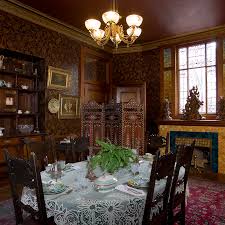
Dining Room: table settings for the oyster course of one of Clemens’ famous dinner parties
Conservatory (the daughters called it the “Jungle”: the (still!) working water fountain
First floor guest room: indoor plumbing for the tub and flushing toilet
Bedrooms: “speaking tubes” where family members could “call” down to the kitchen and maids
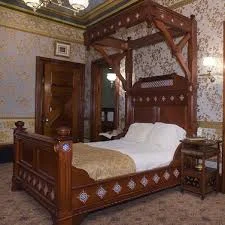
Master Bedroom: the massive head and footboards that Clements was duped into thinking were from the Italian Renaissance
Nursery: filled with with a doll house, tea party set up, doll carriages, and plenty of play dolls.
Third floor hallway: Iconic painting of Samuel Clemens
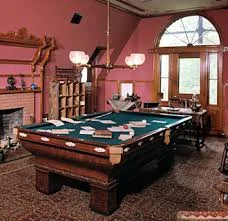
Third floor Billiards Room: billiards table and Clemens writing desk(s). Clemens had two desks: one that faced the billiards table and one that faces a blank wall, where Clemens actually wrote, not distracted by the game.
Kitchen: a sample menu for an eight course dinner party that Clemens and his wife routinely held.


Eating Nearby: The Nook Farm Cafe is located on the second floor and offers pre-made sandwiches, snacks, sweets, and drinks, many of which are from local establishments. Hartford is filled with plenty of full service restaurant options. Check here for a good list.
And for more fun in Connecticut, check out our list of 30 places we love, 32 places to eat in Connecticut and our index of posts on family friendly spots in Connecticut
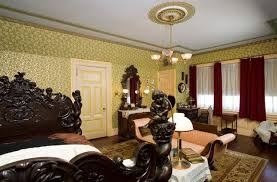
Disclaimer: I was provided a media pass to visit the Mark Twain House and Museum. All opinions expressed are my own. Interior photos are courtesy of the Mark Twain House & Museum, as photography is not allowed inside the house or museum.