Touring the Assemblée Nationale du Québec in Québec City

| |

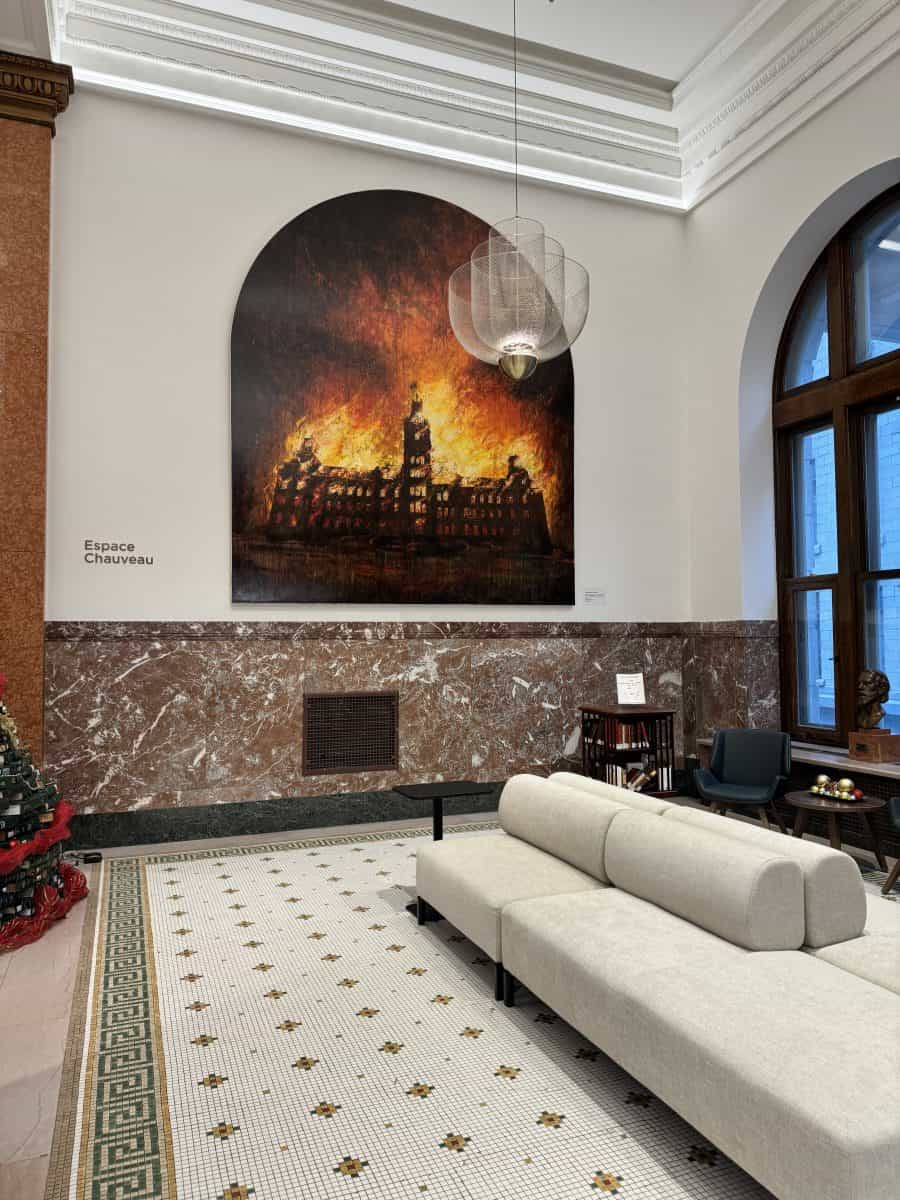
On a recent trip to Québec, Canada, we made sure one of our first stops was a visit to the Parliament Building, home of the National Assembly, to learn all about French Canadian government.

A National Historic Site, the National Assembly Parliament Building was built between 1877 and 1886 on Parliament Hill, inspired by the architecture of the Louvre in Paris. Old Quebec housed the first three parliament buildings but all three burnt down before the current building was built from 1877-1886 and designed by Eugéne-Étienne Taché. In the early 1900s, several buildings were added for additional office space.
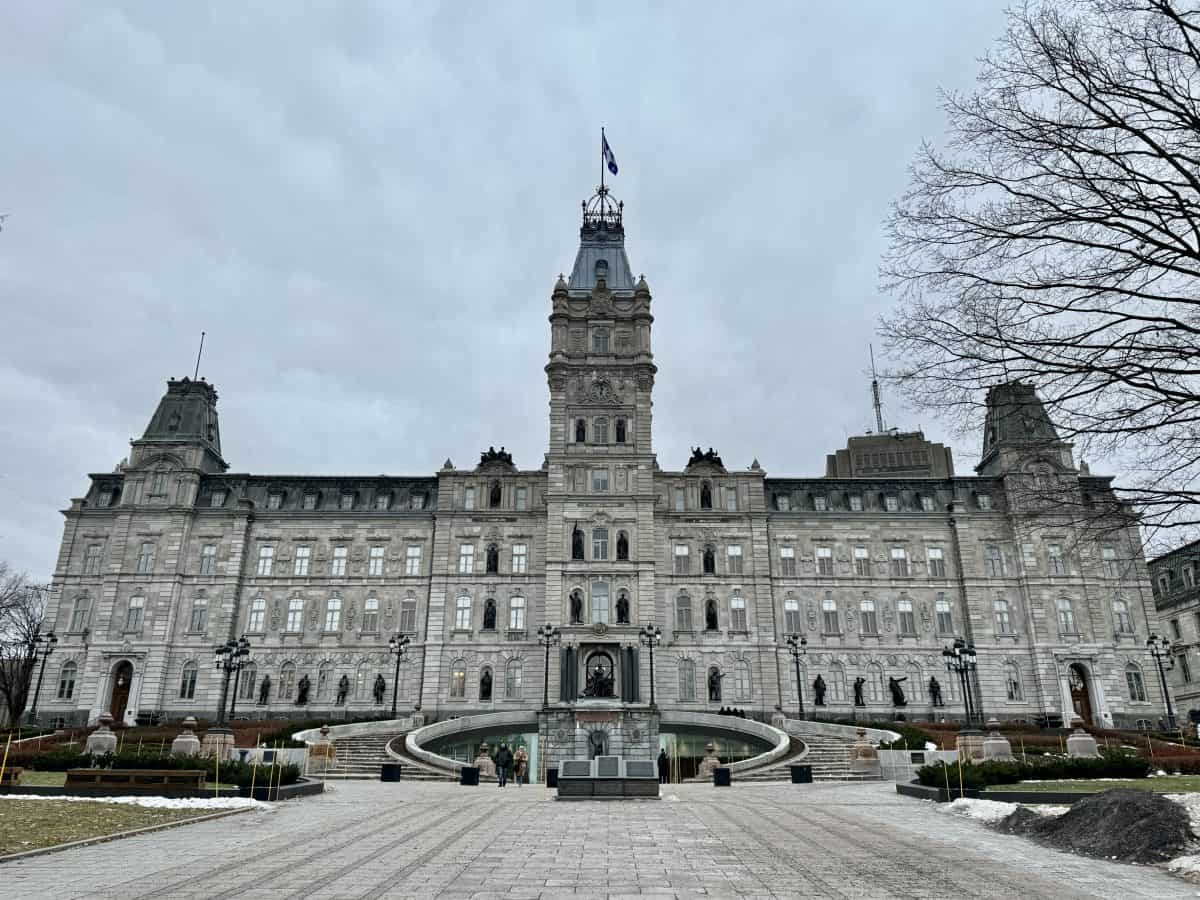
The eight-floor Parliament building consists of four wings with a square courtyard in the middle. The left side of the building, facing south, honors Québec and its founder Samuel de Champlain and the right side of the building, facing north, honors Montreal and its founder Paul de Chomedey de Maisonneuve.

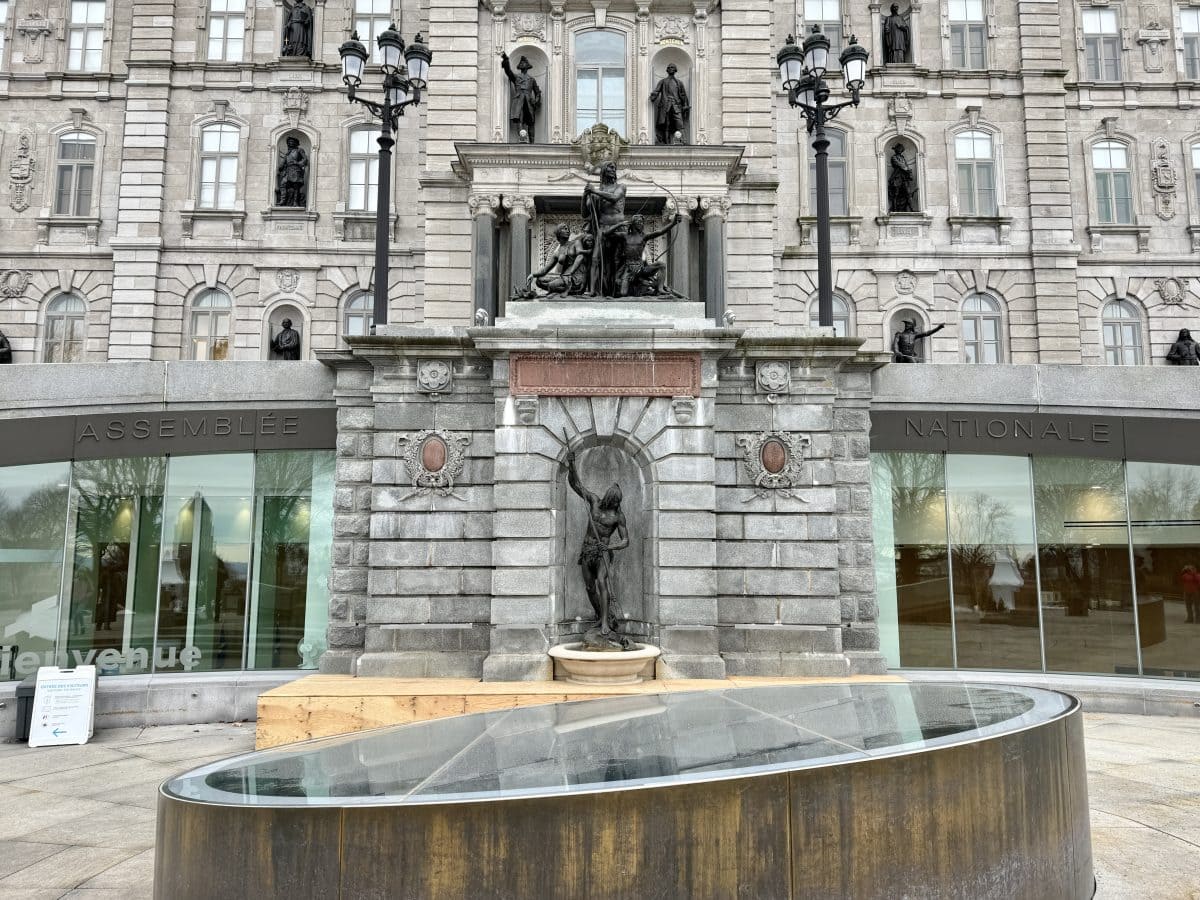
The grounds of the Parliament Building feature several statues honoring influential political, religious, and military figures in Quebec’s history, as well as a fountain in front of the main entrance. The Reception Building was completed in 2019 and offers state of the art security, spaces for meetings and receptions, and additional exhibit spaces for art work and historical artifacts.
The Assemblée Nationale traditionally meets beginning mid February for 16 weeks of “sittings” with two additional weeks of extended sittings, and then again starting in late September for ten weeks of “sittings”, followed by two weeks of extended sittings. Visitors are welcomed all year to tour the building and explore the adjacent library. The Parliament Building is a wonderful place to learn about, and see in action, Quebec’s government, and is very kid friendly.

Travel Tips:

  • Information on self guided and FREE, guided tours (usually Monday through Saturday) can be found here. We highly recommend making reservations for guided tours ahead of time here
  • The main entrance for all visitors is the (new-ish) Reception Building underground, with the entrance to the left of the main building. Check out this map for a visual. 
  • All visitors must pass through metal detectors and security and show photo ID (anyone over the age of 18) before obtaining passes to explore the campus. Badges must be worn while on the campus.
  • The closest place to park is the Convention Centre, the Édifice Marie-Guyart and the Édifice H.  Information on public transportation here. The campus is also very walkable from other popular attractions. 
  • A coat check and restrooms are located in the Reception Building after admissions.
  • La Boutique, a small gift shop is located just past the restrooms in the Reception Building, offers a curated collection of souvenirs and gifts. 
  • The tour and public areas are accessible via an elevator.
  • Restaurant Parlementaire is open to the public for lunch when the Assembly is in session; reservations are highly suggested. The Café du Parlement is a good option for quick service and grab and go items. 
  • Check out special programs and events open to the public here
  • Guided tours last between 60-75 minutes and are offered in French and English (and Spanish, by reservation).

10 Stops on the Tour of the Assemblée Nationale:

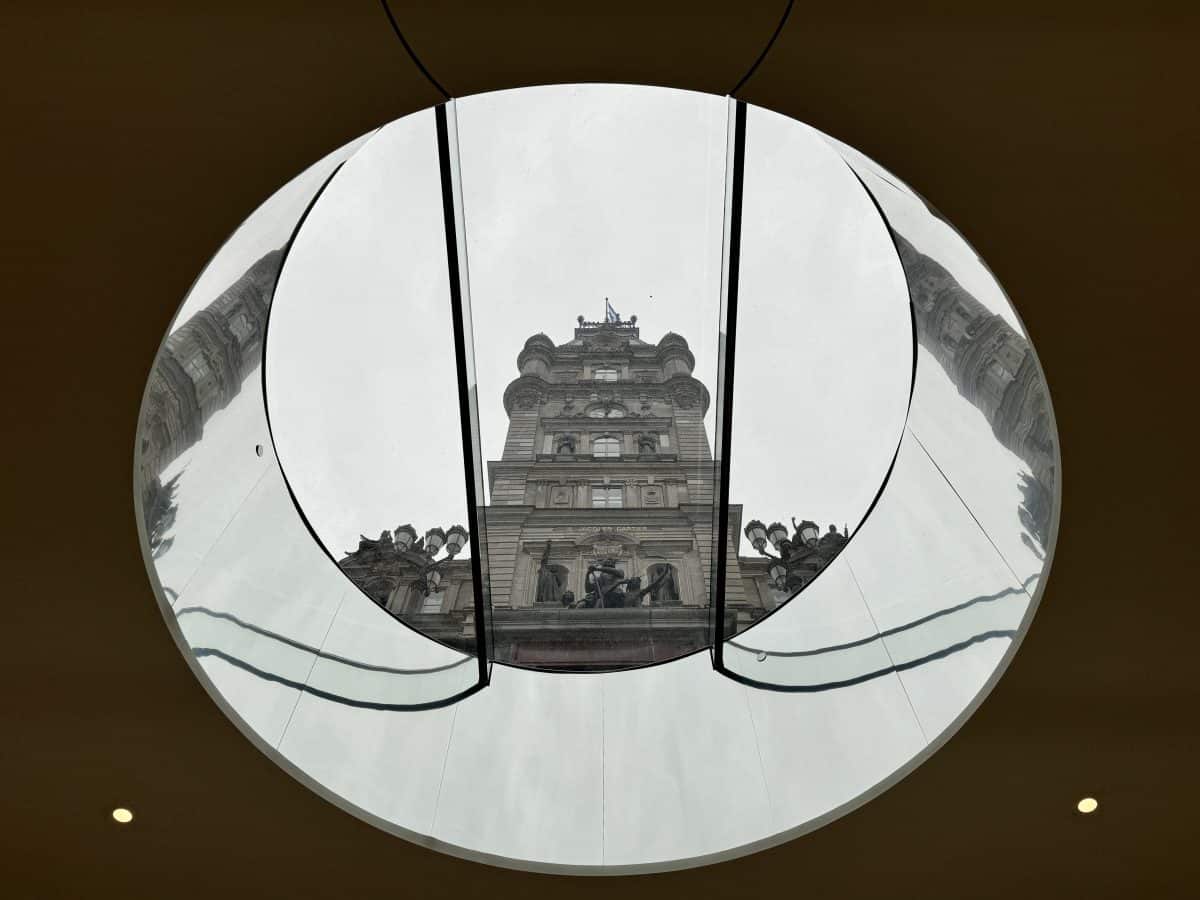
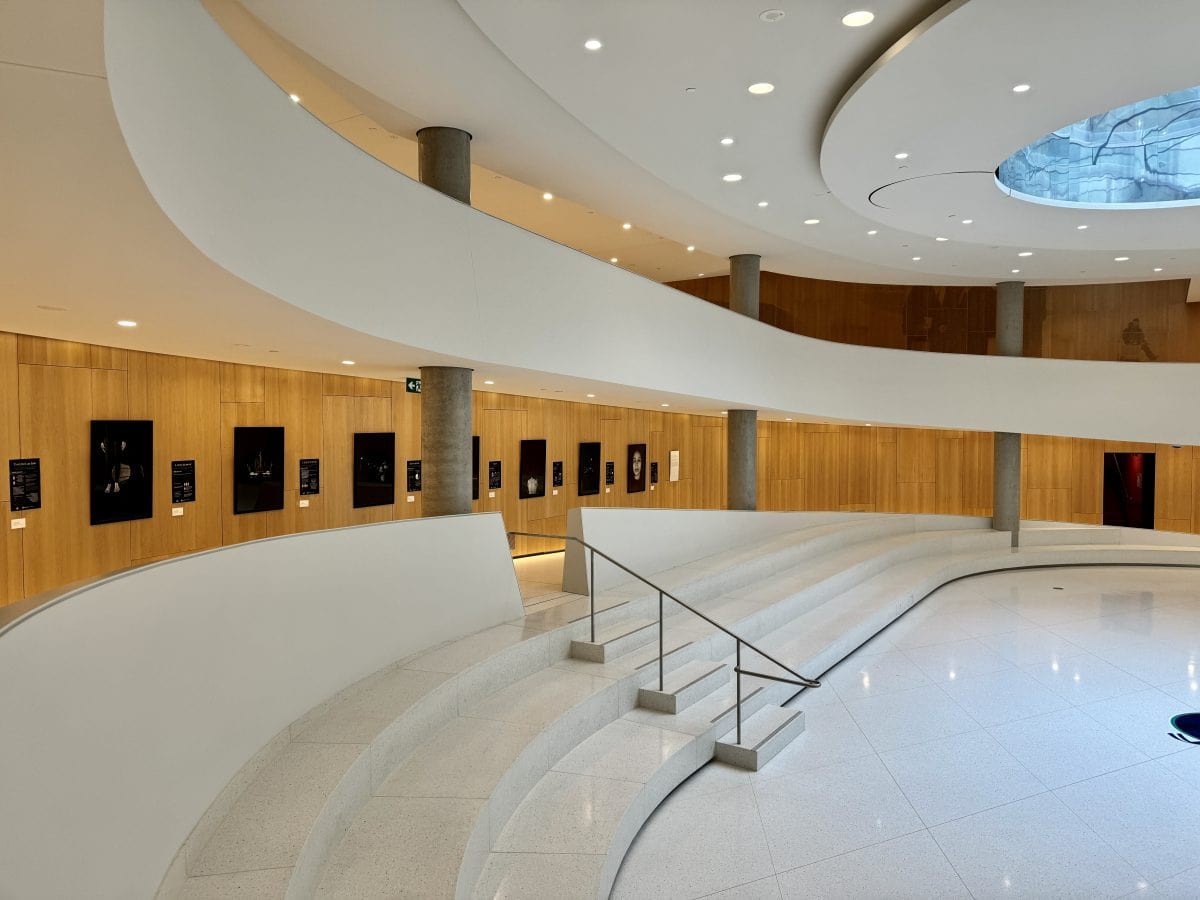
  1. Before the tour starts, explore the exhibition spaces in the Reception Pavilion. There are displays providing background on the Assembly (see photos of all 125 current members) and the history of the building. Peak down into the Parliamentary Committee Rooms through a window and then look up at the Oculus skylight in the Agora, which is the heart of the campus and zero kilometers from every street in Quebec. The skylight provides a unique angle to two statues outdoors “Spirit of Fish” and “Family” both of indigenous people dating back to 1890 and 1891. 

Would you like to save this?
We'll email this post to you, so you can come back to it later.

  1. Walk through Jonathan Villeneuve’s Spectrum of Enlightenment artist tunnel that changes color and light based on the body temperature of individuals walking through it. It was created in 2018 and includes 360 elements. There are special effects each day at noon and 6pm.
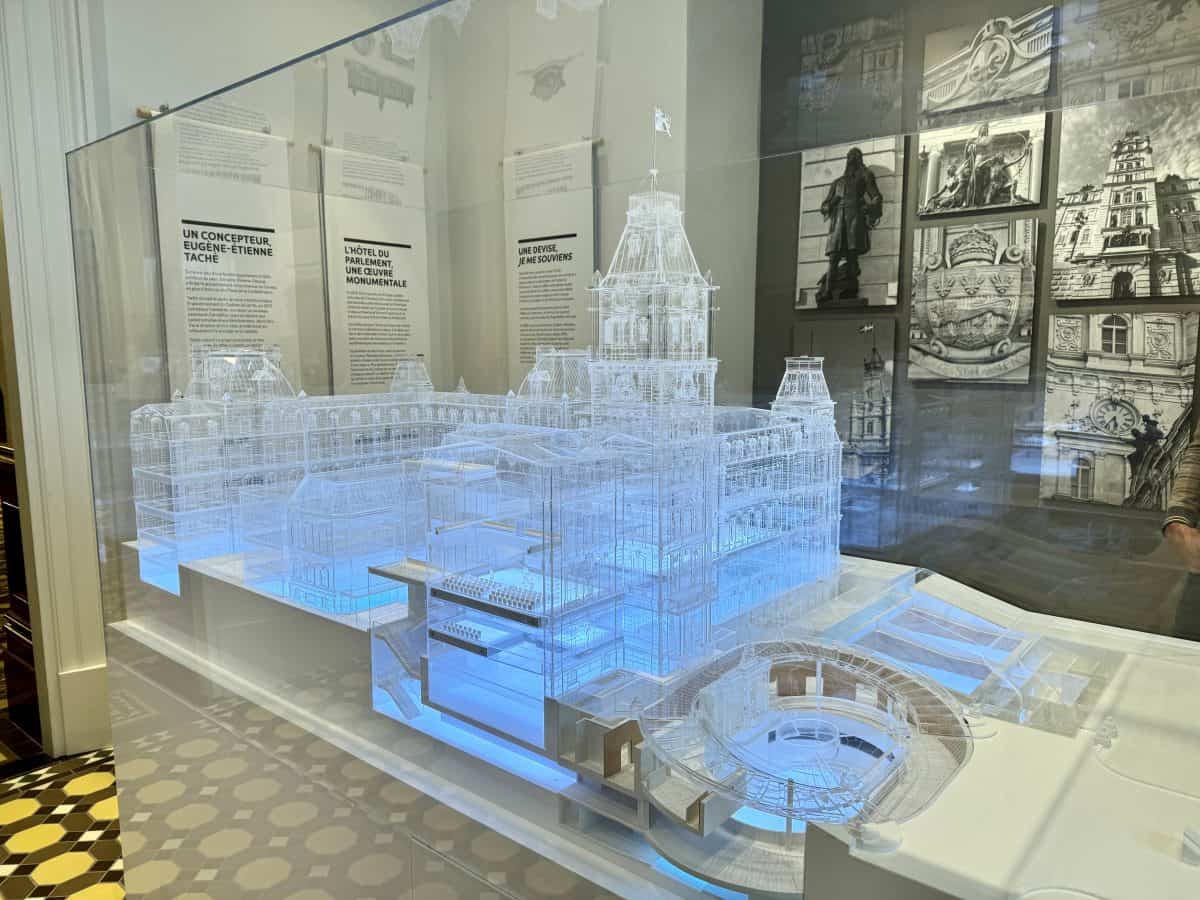
  1. Get an up close look of the entire campus with the large transparent models of the Parliament buildings. Light up panels provide exact locations of various offices.
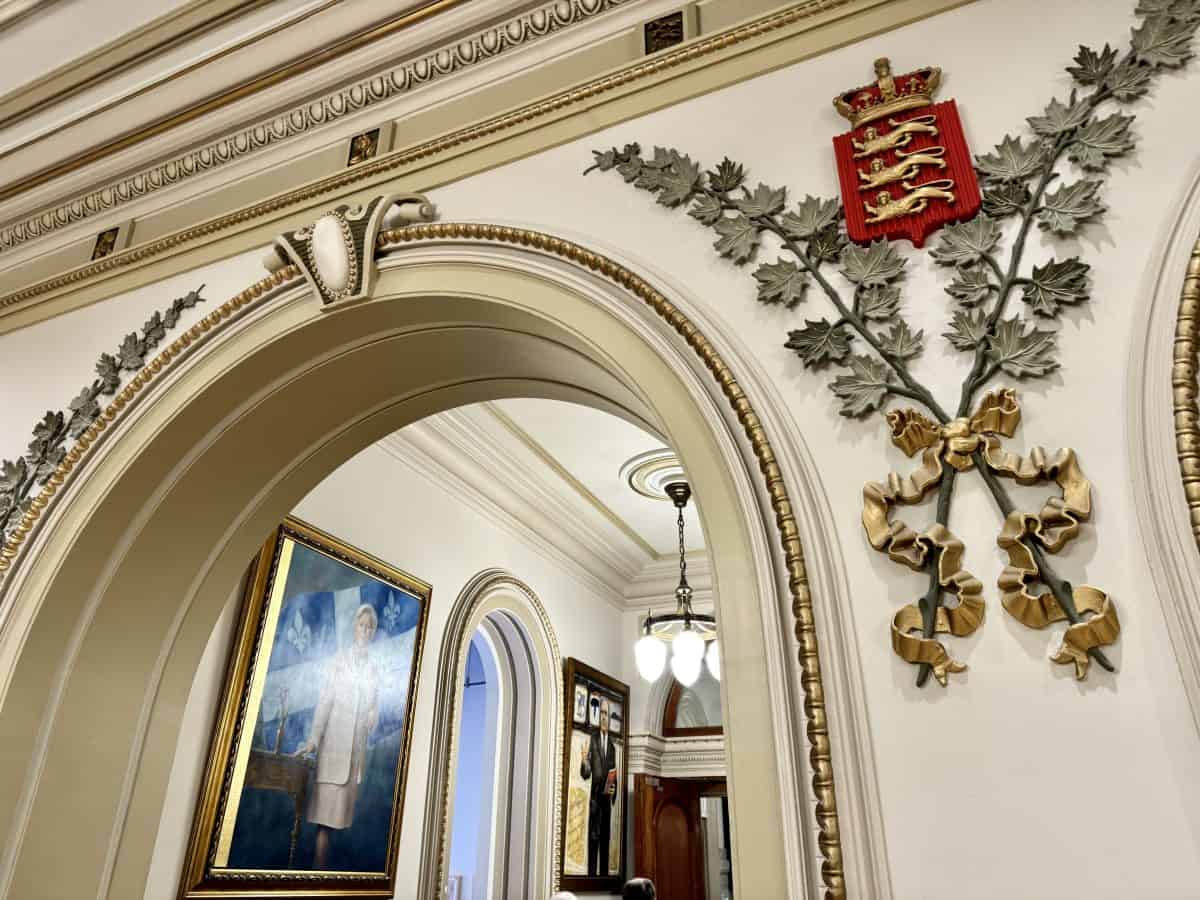
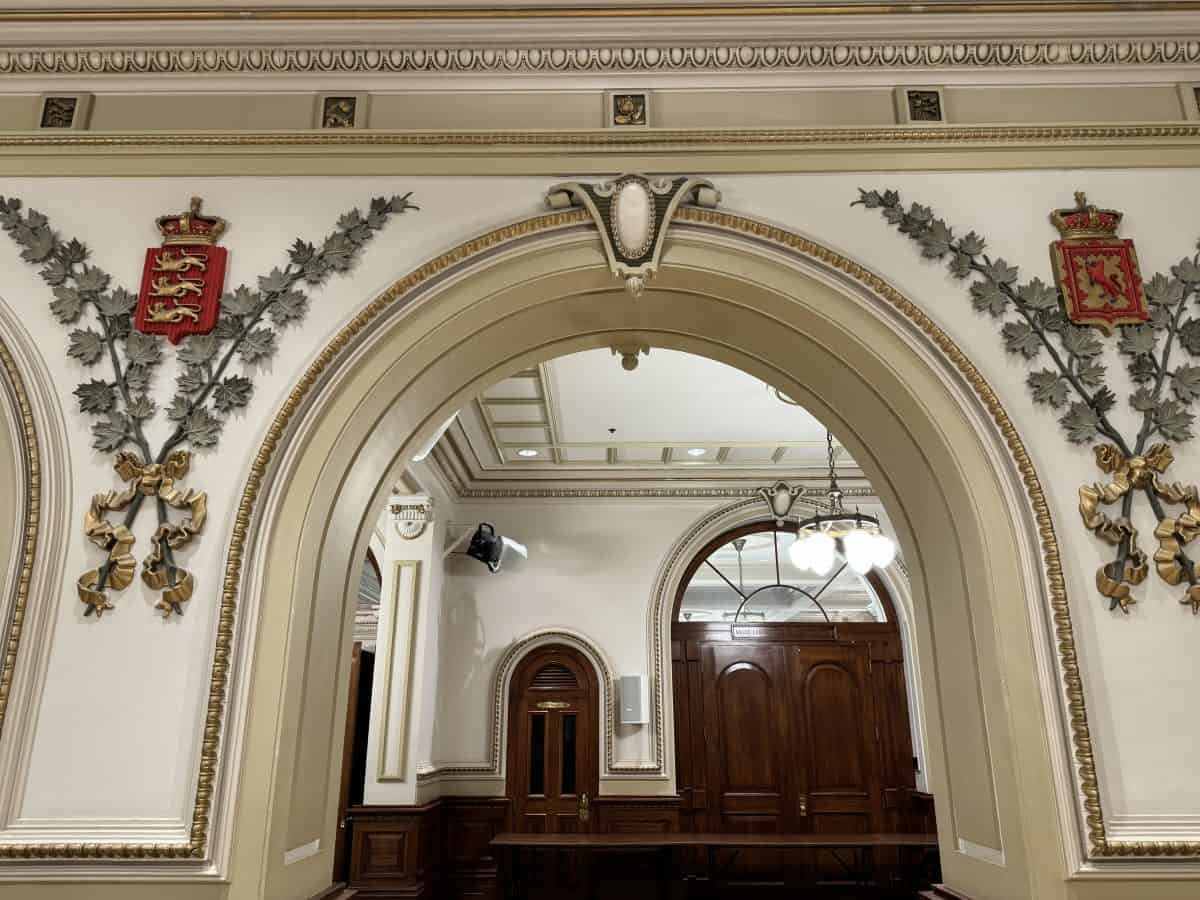
  2. Find the four coats of arms on display in the Main Lobby, representing the French, English, Scottish, and Irish. All four coats of arm are surrounded by green maple, the symbol of French Canadian settlers. When the Assembly is not in session, the mace used by the Sergeant of Arms is on display. 
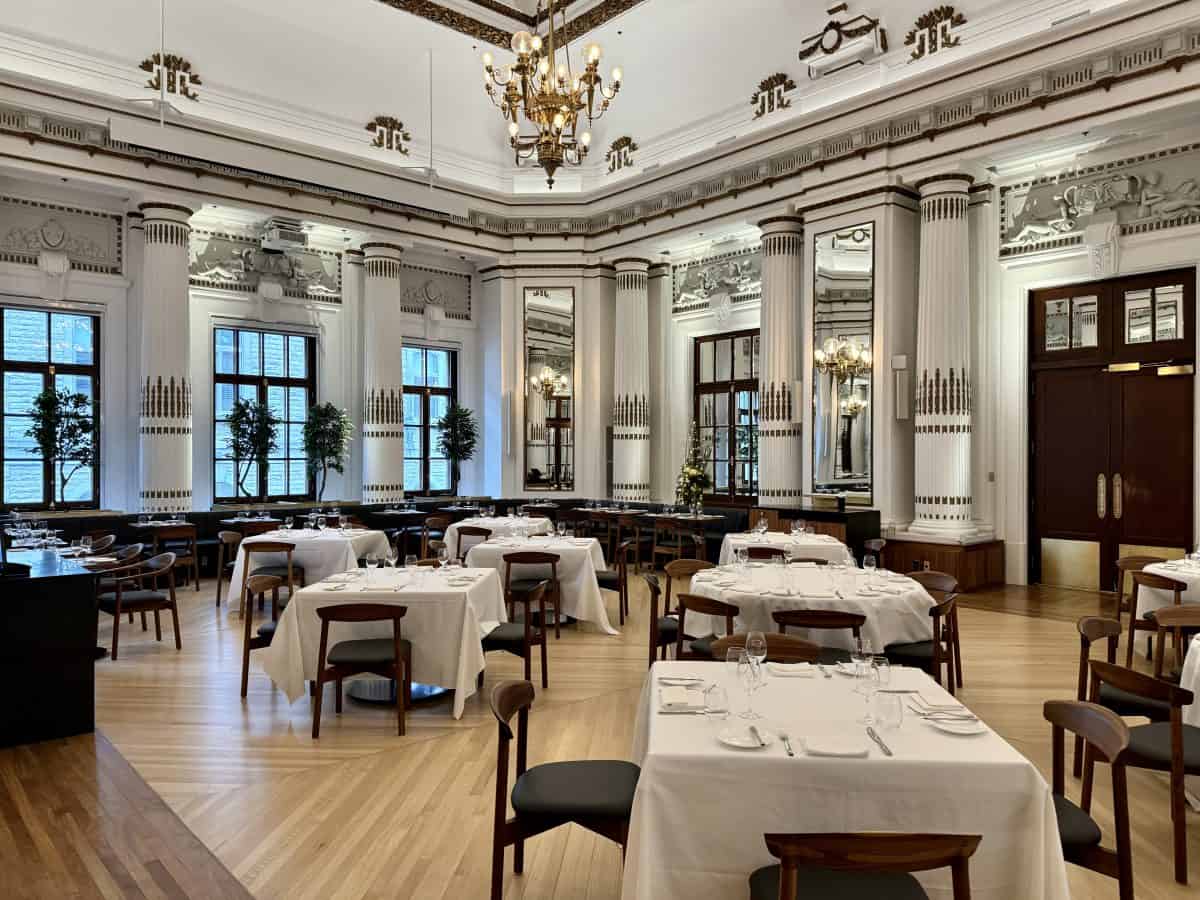
  3. Peek inside, or even have lunch, the Restaurant Parliament, where elected officials and their guests can dine. Visitors may also make reservations for lunch, which includes all locally grown produce, including veggies from the garden and honey from the rooftop beehives.
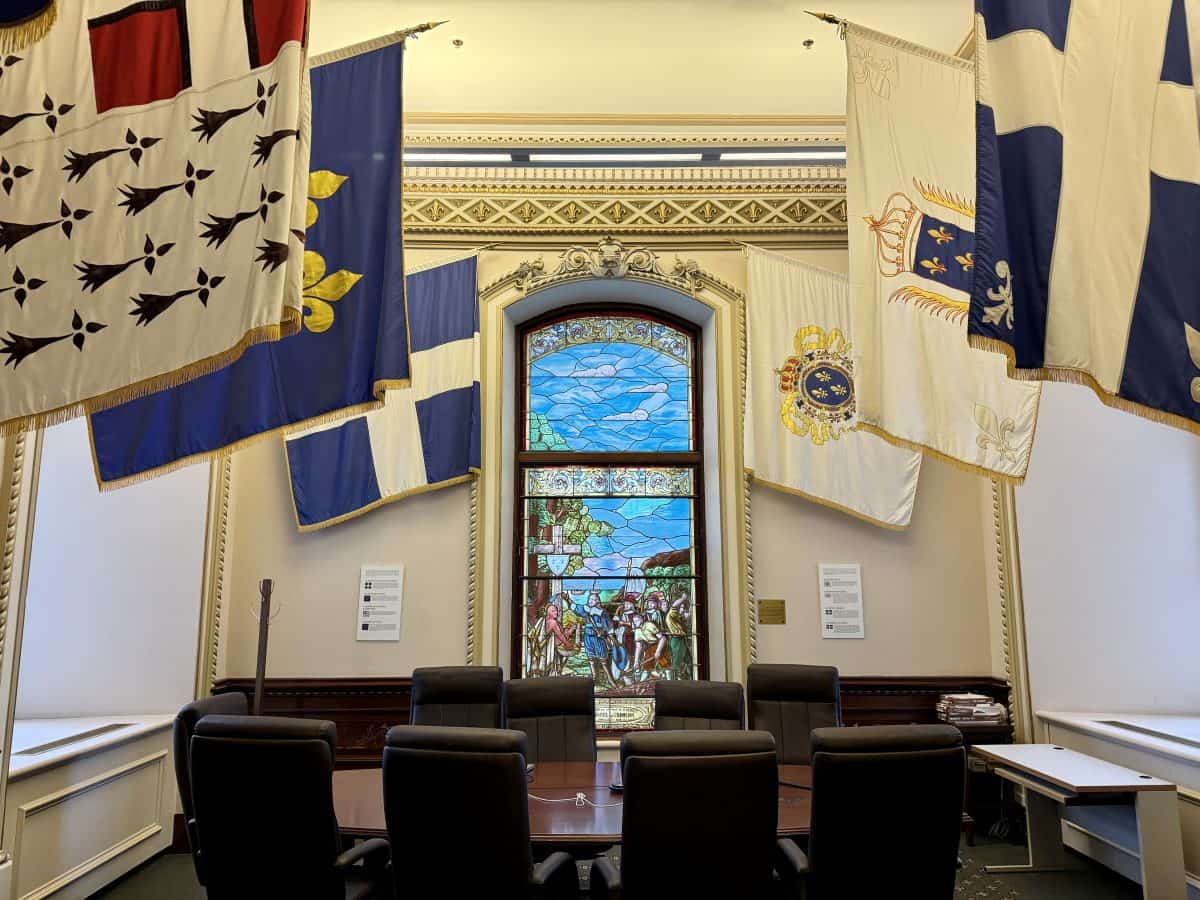
  1. Count the flags on display in the Flag Room, used by the President to hold small meetings and press conferences. The historic flags include maritime flags, flags from the Battle of Carillon, the current Québec flag, and three flags from France.
  2. Peek inside the red Salle Du Conseil Legislatif, currently under renovation and no longer open to the public for meetings. The Conseil Legislatif was abolished in 1968 and the room is only used for ceremonial gatherings and swearing in of members.
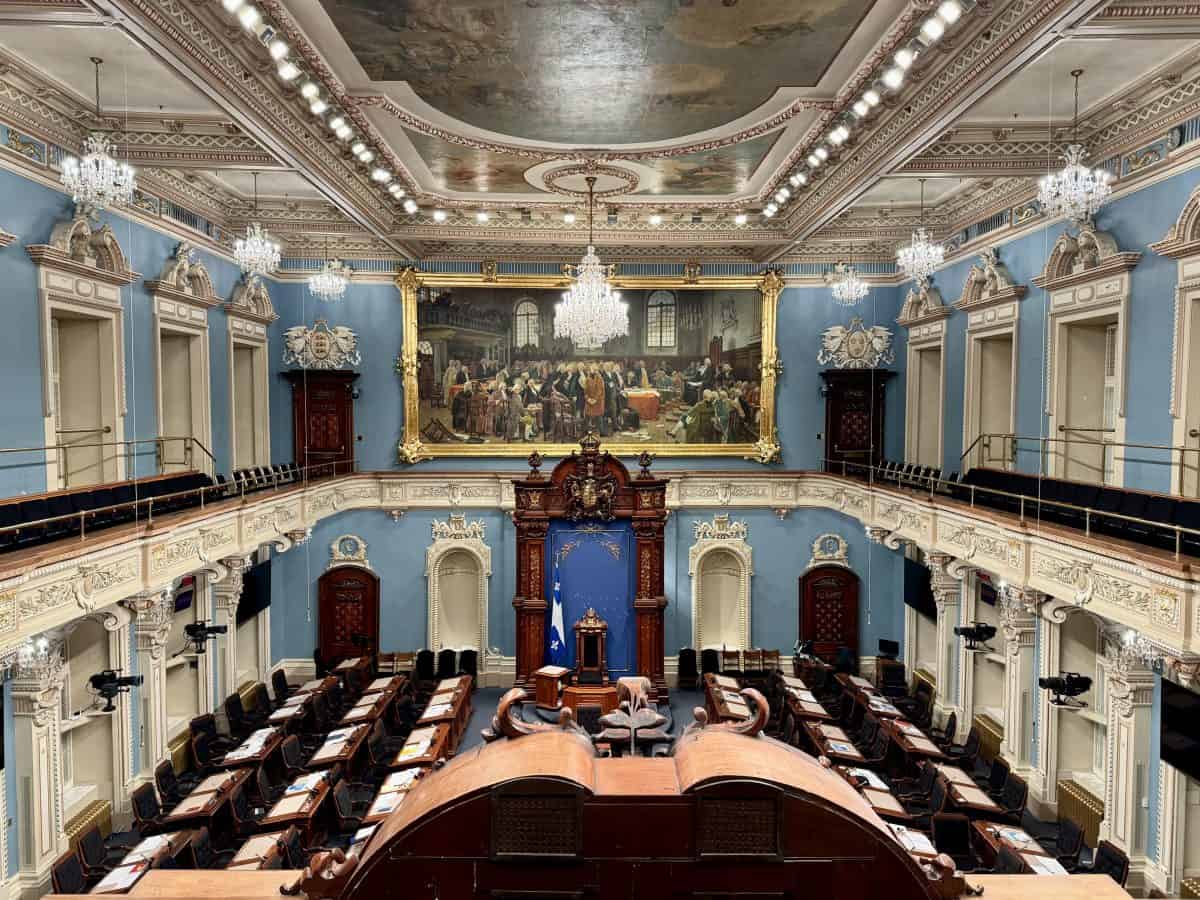
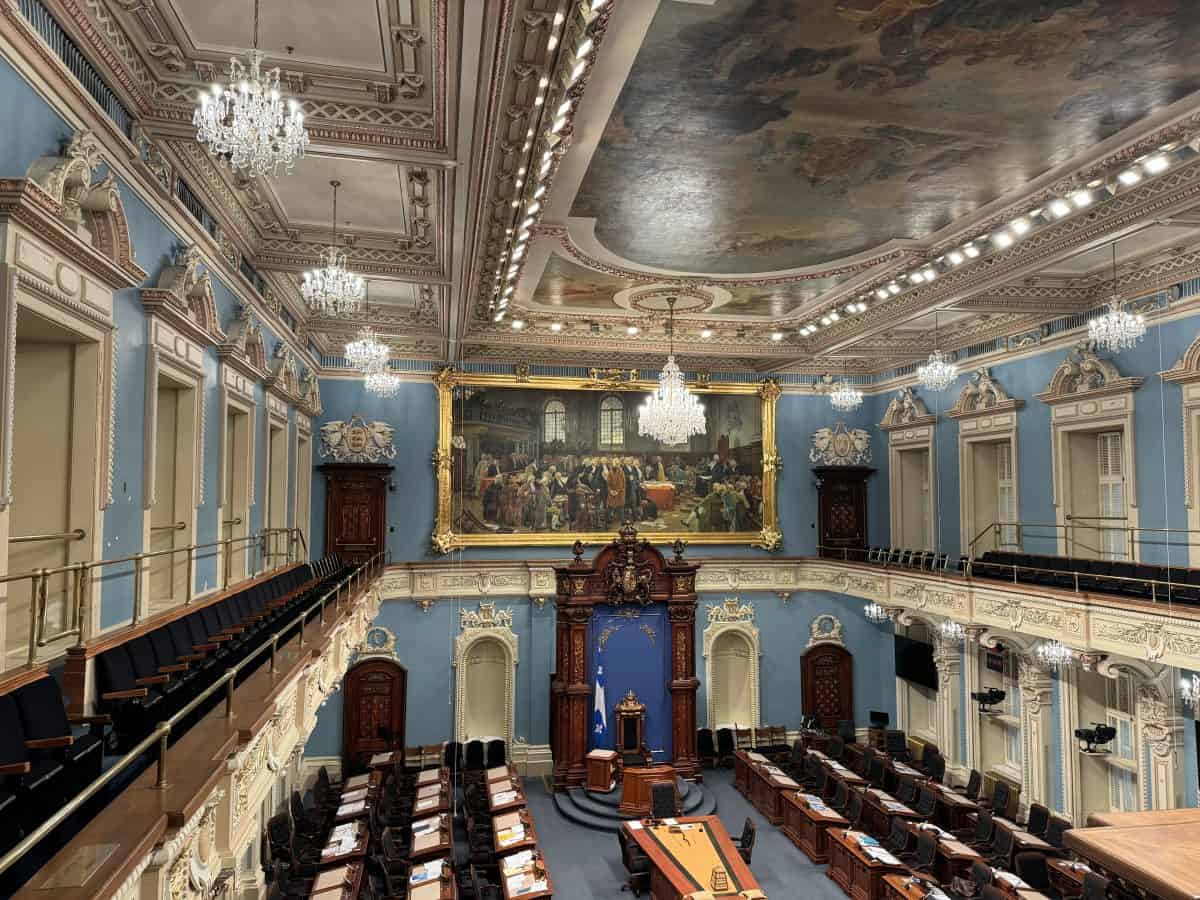
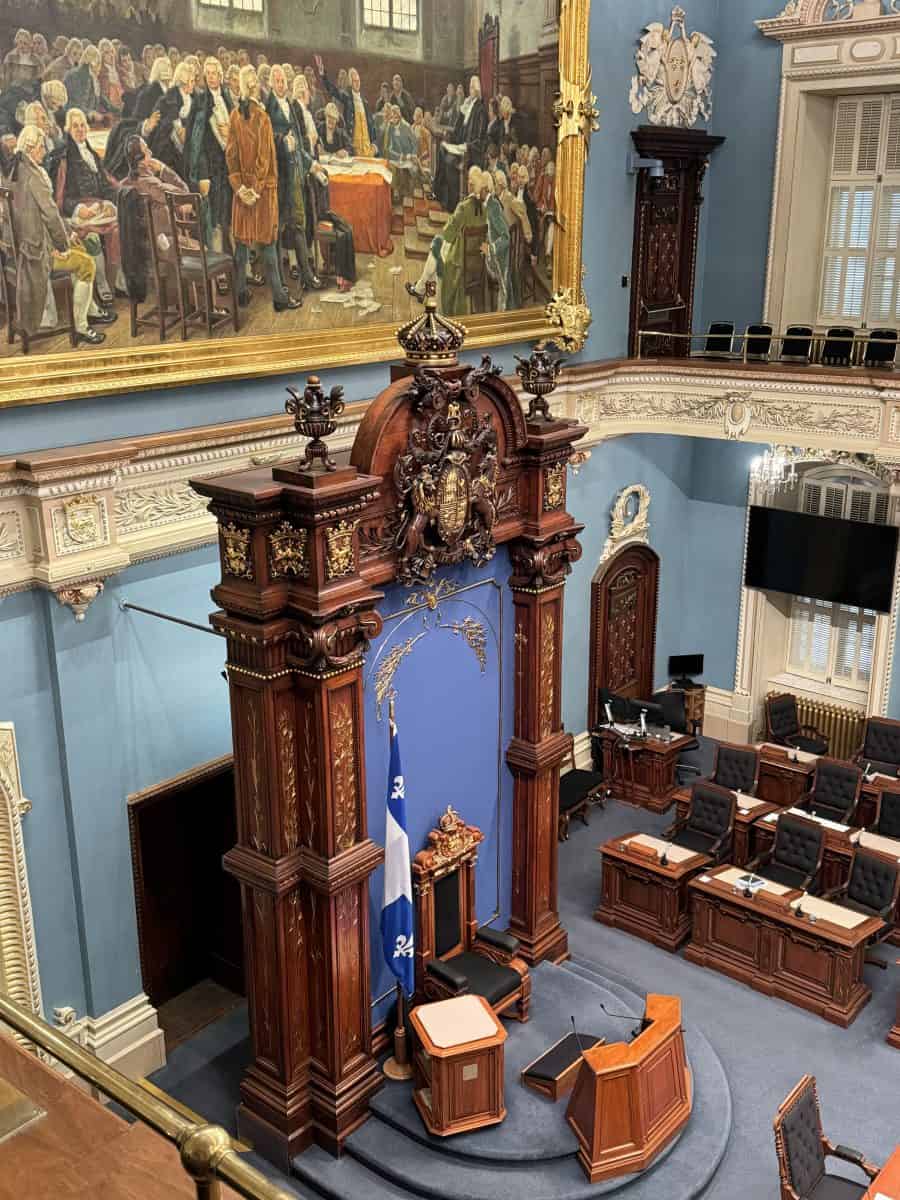
  3. Walk the perimeter of the upper chamber of the Salle de L’Assemblee Nationale, the famous blue room where the Assembly meets. All 124 members are elected every four years on the first Monday in October. Check out the pedestal at the head of the room where the President sits, and the large angular table for the mace. Visitors are allowed to sit on the sides and back of the upper chamber, and journalists sit in the front section of the upper chamber behind and below the clock. The large painting above the pedastal depicts the first debate of the first Parliament of Quebec in 1792. Note that the room should be painted green, but because the coloring was not flattering on camera, the room is painted blue.
  4. The drawing of famous scenes and relevant images from Quebec’s history is displayed on the walls of the President’s Gallery exhibitions.
  5. While not part of the tour, leave time to visit the Library, located in adjacent the Pamphile-Le May Building, named for a former library director. The Library was created in 1802 and has since added over 2.3 million documents to its collection. 

Bonus: Leave time to walk the grounds and see some (or all) of the 26 statues honoring historic explorers, soldiers, politicians, and missionaries. Read more about the honoree here

Looking for other adventures in Québec? Check out our posts featuring the Musée de la Civilisation, the Morrin Centre, Le Monastère Des Augustines, La Citadelle de Québec, the Plains of Abraham Museum, and the Auberge Saint Antoine hotel. And follow along on our adventures on Instagram, Facebook, Pinterest, and X.

Similar Posts

  • | | |

    The Paley Center for Media in Manhattan

    First opened in 1976 as the Museum of  Broadcasting, the Museum of Television and Radio changed names and moved to the heart of Midtown Manhattan in 1991, followed by another renaming and reopening as the Paley Center for Media in 2007 to honor William S. Paley. The owner of several prominent radio stations in the 1920s, William S. Paley created a larger network that became the CBS Network in the mid 20th century. 

  • | | | | |

    Nat’l Museum of Dance & Hall of Fame, Saratoga Springs NY

    Day 2 in my weeklong posts on Saratoga Springs, New York.

    As a child, I spent fourteen years in ballet and tap classes. I even considered going to Skidmore College because I was so passionate about wanting to dance, but ultimately decided to follow a different career path to teaching. However, my love for dance has never ceased. So when I was planning a family trip to Saratoga Raceway and saw that the National Museum of Dance and Hall of Fame was five minutes away from the track, I knew we needed to make a stop. After spending the morning at Saratoga National Historic Site (read about my tips here) it was a quick 15 minute drive into town to the museum.

    The museum and Hall of Fame are located inside the Saratoga Spa State Park, which is home to performing arts centers, museums, pools, a golf course, and a resort and spa.  From the outside, I must admit I thought the museum looked a little dated. However, once inside, I noticed that is beautifully maintained and full of really fun, unique exhibits. It’s definitely worth a stop for a couple of hours before you head to the race track.  Bonus: Admission is free on Tuesday, when we visited. The museum is closed Sunday and Monday.

  • | | | | |

    Exploring the Saint Croix Island International Historic Site in Canada and the United States

    This past summer, we enjoyed a wonderful week exploring St. Andrews by the Sea in New Brunswick, Canada.  On our drive into town, we passed the Canadian side of the Saint Croix Island International Historic Park and made a note to stop on our way home. We researched the area a little bit and realized we could also explore the American side of the park, with a very short detour once we were back in America in the state of Maine- see a good map of both areas here. Saint Croix Island was declared a national monument in 1949 and then redesignated as an international historic site in 1984. 

  • Year in Review: Highlights of 2021

    Even though 2021 was the second year impacted by the COVID 19 pandemic, we feel blessed to still have had many amazing adventures. We spent most of the winter in Connecticut exploring many local spots; the summer road tripping across Utah, Colorado, South Dakota, and Wisconsin (did we mention the number 4300 miles?!?!); and the spring and fall revisiting some of our tried and true favorite spots for new activities. This post is always one of our favorites each year, as it’s fun to go back down “memory lane” and reflect on the best parts of each adventure. So here is a recap of our (documented, publicly shared) 2021 adventures:

  • Playing “I Spy” at the Colorado State Capitol

    Visiting about a state’s history is one of our favorite activities and whenever we’re in a capital city, we make time to tour the state Capitol complex. The buildings are architecturally beautiful and the guides are usually enthusiastic, knowledgeable, and engaging. To date, we have toured capitol buildings in Massachusetts, Rhode Island (#5), New York, Pennsylvania, Virginia, and Arkansas (#6). On our summer 2021 road trip, we spent the day in Denver (we were in town primarily to see the Rockies) and made time for a tour of the Capitol.

    At one time, Denver was the second largest city in the West (behind San Francisco) and was part of the Gold Rush of the 1860s. Originally, what is now considered the state of Colorado was part of the Kansas, Nebraska, Utah, and New Mexico territories. In 1861 Colorado was declared a territory and became the 38th state in America. At first, Colorado City and then Golden were declared state capitals until 1867 when Denver became the permanent state capital. Construction on the Capitol building started in 1886, was completed enough for the building to be occupied in 1893, and then fully operational in the early 1900s. The building was designed on an axis in the form of a Corinthian Cross and closely resembles the design of the Capitol in Washington, D.C.

  • | | | |

    Touring the Maryland State House in Annapolis, Maryland

    On a recent visit to Annapolis, Maryland, we enjoyed learning all about the history of the state, and significant American history, while touring the State House in the heart of Annapolis.

    Annapolis, Maryland was the capitol of America from November of 1783 through August of 1784, the first peacetime capitol and the only state house that served as America’s capitol. It is the oldest state house still in continuous legislative use and was the site of both George Washington’s resignation as Commander in Chief of the Continental Army in December of 1783 and the ratification of the Treaty of Paris, which ended the Revolutionary War in January of 1784.

    The original State House was built in 1735 and renovated in 1876-1877, with an annex built in 1905, identified by the black strip of flooring on the first floor. There were significant update in 1940 and an additional, thorough restoration project in 2014. Today, construction continues at the front entrance, in the old Treasury Building, and across the street with the Department of Legislative Services building.  The first floor of the State House remains open to visitors for self guided tours, and several interactive exhibits are engaging for visitors of all ages!

7 Comments

  1. Wonderful display and explanation!
    I’m sorry we missed it so long ago. Interesting for both adults and children. Thank you.

  2. I love the history content on this. It’s an interesting backstory. I didn’t know much about this Parliament Building until this post. For me, I find the architecture and the style so lovely and unique, especially, the artist tunnel that changes color and light based on the body temperature of guests walking through it. That’s amazing!

  3. Quebec is on our fall itinerary this year and this is great! I would have never even entertained a visit to the Parliament Building. Adding the Spectrum of Enlightenment artist tunnel on my plan, thank you for sharing these fun tidbits!

  4. Quebec’s provincial government is slightly different then rest of Canada. They call it the National Assembly not legislature as other provinces do. Like the rest of Canada all the provinces have a premier
    ( not president). some aspects of Quebec’s legal system also different then rest of Canada because of its history as French and British colony.

Leave a Reply

Your email address will not be published. Required fields are marked *