Playing “I Spy” at Canterbury Shaker Village in New Hampshire

| | |

On a  recent trip to beautiful Concord, New Hampshire we stopped at nearby Canterbury Shaker Village for an afternoon of exploration and learning about the history and lifestyle of the Shakers.

The Shakers first formed in the early 1700s in England. Known as “Shaking Quakers” because of their erratic dancing during worship, the founders were previously members of other religious groups, including English Quakers and Methodists. A group of nine people, led by Mother Ann Lee, came to New York in 1774 to build “Heaven on Earth” and eventually made their way to Canterbury, New Hampshire, just north of Concord, in the early 1790s. 

Canterbury Shaker Village in Canterbury, NH

At their peak, there were 19 Shaker Villages spread out from Maine to Kentucky. Today (as of 2023), only two Shakers remain at the Sabbathday Lake Shaker Village in Maine.  Shakers believe that time was a gift from God and that humans should work hard to never waste time.They also had doctrines that specified communal ownership, pacifism, equality of the sexes, and celibacy. While they believed in living simply, they did not oppose technology and were some of the first groups to have technology (Shaker buildings had electricity four years before the State House did!).  Shakers are credited with inventing and improving upon many ways to make daily chores easier and simpler, and the Shakers are considered the most successful communitarian society in American history. 

Canterbury Shaker Village officially opened in 1792 with the Meeting House and added several buildings over time, including the 1890s creation of the Turning Mill Pond, which brought water to the village and fueled most of the operations. The Canterbury Shaker Village thrived in the mid 1800s, with approximately 300 people living and working throughout the village’s 100 buildings, but started to decline in numbers in the early and mid 1900s. The Shaker order was closed in 1950 and would not accept new members. The Shakers tried many ways to earn income (such as sewing the famous Shaker sweaters for Ivy League college students) in order to preserve their community and opened the Village as a museum in 1969 while there were still five sisters living on the property. The last sister of the order passed away in 1992 and the following year, The Village became a National Historic Landmark.

Today, guests can tour parts of the nearly 700 acres of property, which include 25 original and 4 reconstructed Shaker buildings, as well as open fields, gardens, and mill ponds. Self guided tours are allowed on the property from dawn to dusk, but only guided tour guests may go inside the buildings. 

Travel Tips:

  • The village is open from dawn to dusk and guided tours are typically offered a few times a day Tuesday through Sunday from mid May through October; check here for up to date information on hours and admission fees.
  • Check the schedule for special events open to the public like Music on the Green  on Sundays all summer. 
  • Plenty of free parking in the lot next to Horse Barn and across the road from Carriage House Building (admissions). 
  • Wear closed toe shoes for the tour, as tours walk through uneven ground. Tours are not handicap accessible, and do climb flights of stairs to the second floor of some buildings. To see what is handicap accessible, check this map. 
  • Restrooms are located in a lower level building across from the Carriage House building.
  • A gift shop, admission desk, and exhibit with introductory video (approximately 7 minutes) are located in the Village Store in the Carriage House building.  
  • There are no dining facilities on site, but here is a good list of recommended culinary options.
  • Tours typically last 90 minutes; plan on a full two hours to explore the exhibits and take a tour- more time if you want to walk some of the trails. See the Village map here and the trail map here. 

Would you like to save this?

We'll email this post to you, so you can come back to it later.

Playing “I Spy” on the Canterbury Shaker Village Tour:

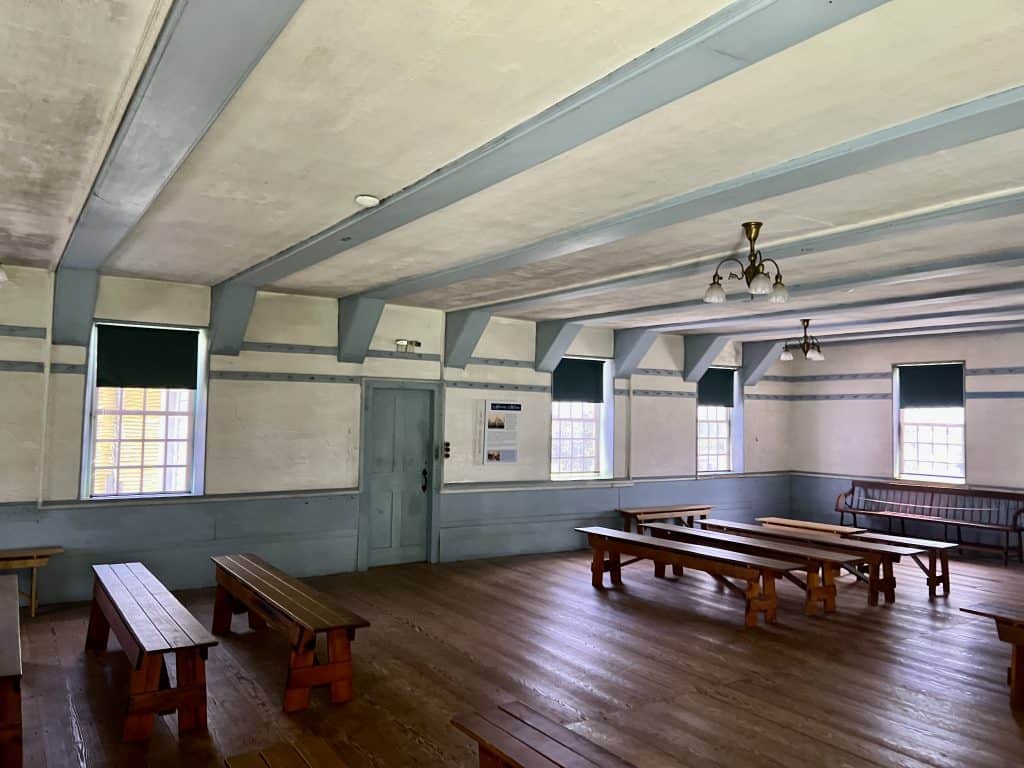
  1. The two doors to enter the Meeting House- one for the men (Northwest) and one for the women (Southeast), who had to sit on opposite sides of the room. The Meeting House  was the first building the Shakers built in 1792. What visitors won’t see in the Meeting House is an altar, pulpit, musical instruments, art work, stained glass windows, or Bibles or books.  The Shakers often gathered for worship on Wednesdays and Sundays for solemn, meditative worship.
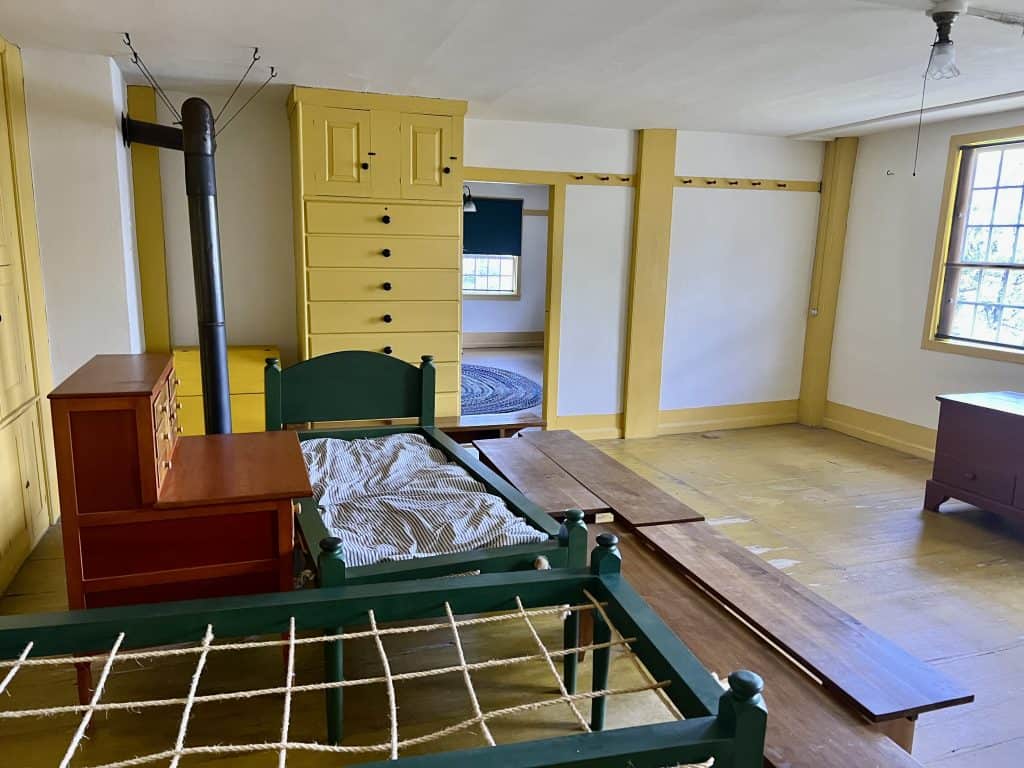
  2. The kitchen setup in the lower level of the Dwelling House. The Dwelling House, the largest building in the Village with 56 rooms, has four stories which housed food prep and the dining room on the lower floor, Administration on the second floor, and separate bedrooms for men and women on the third and fourth floors. 
  3. The original place settings on the dining room tables in the Dwelling House. The table was set to allow for efficient eating (no socializing) and easy clean up- the chairs came from other Shake Villages and were small enough to be tucked under the table or hung on the wall pegs. Shakers ate well, including apple pie at all three meals every day!
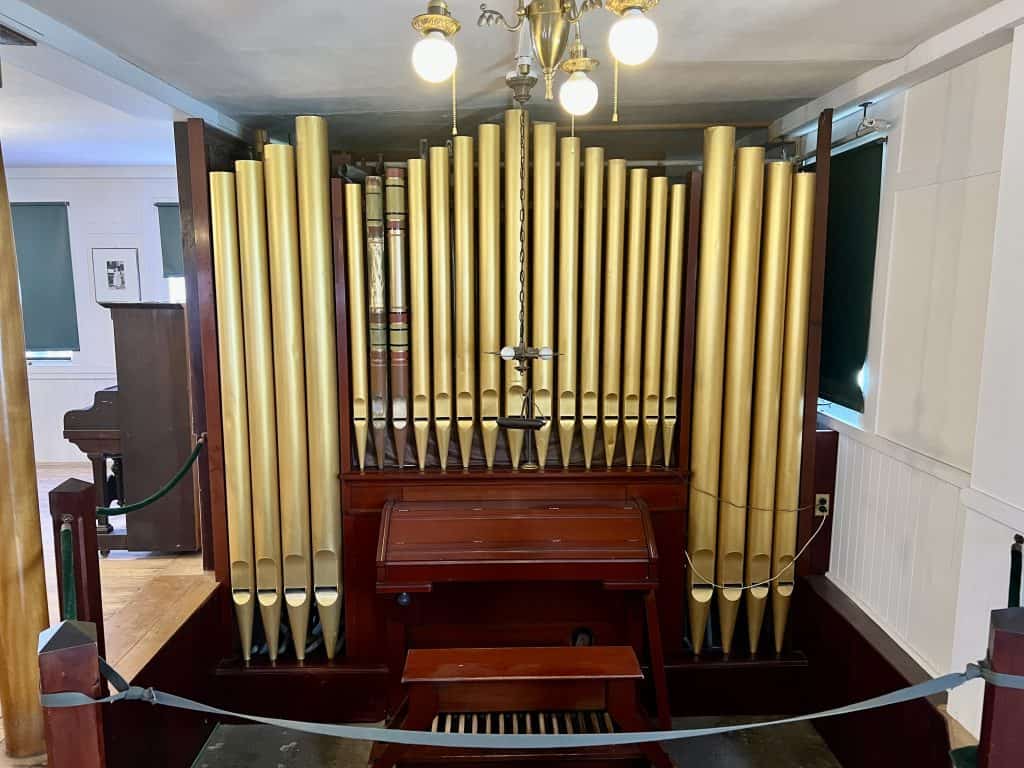
  4. The Chapel organ and pipes which were added in 1920 to the Chapel (built in 1838) on the second floor of the Dwelling House. Today, the Chapel hosts concerts for the public with several instruments, including the organ, showcased. 
  5. The original washing machines that were built by the Shakers in the late 1800s in the Laundry Building.  As is common for the Shakers, they took the strenuous task of washing clothes by hand and built machines that would do the task more efficiently. Their machines were so impressive that local colleges and universities purchased them for campuses. 
  1. The upper level laundry drying racks (built by hand by the Shakers) that would dry dozens of garments at once in the Laundry Building. 
  2. The spools of yarn (crimson red for Harvard, baby blue for Columbia, and dark green for Dartmouth) used by the Sisters to make the famous Shaker sweaters for male college students- one of the ways the Shakers earned money for other necessities in the second floor Laundry Building. 
  3. The wooden cut outs used for stretching drying socks on the second floor Spin Shop. 
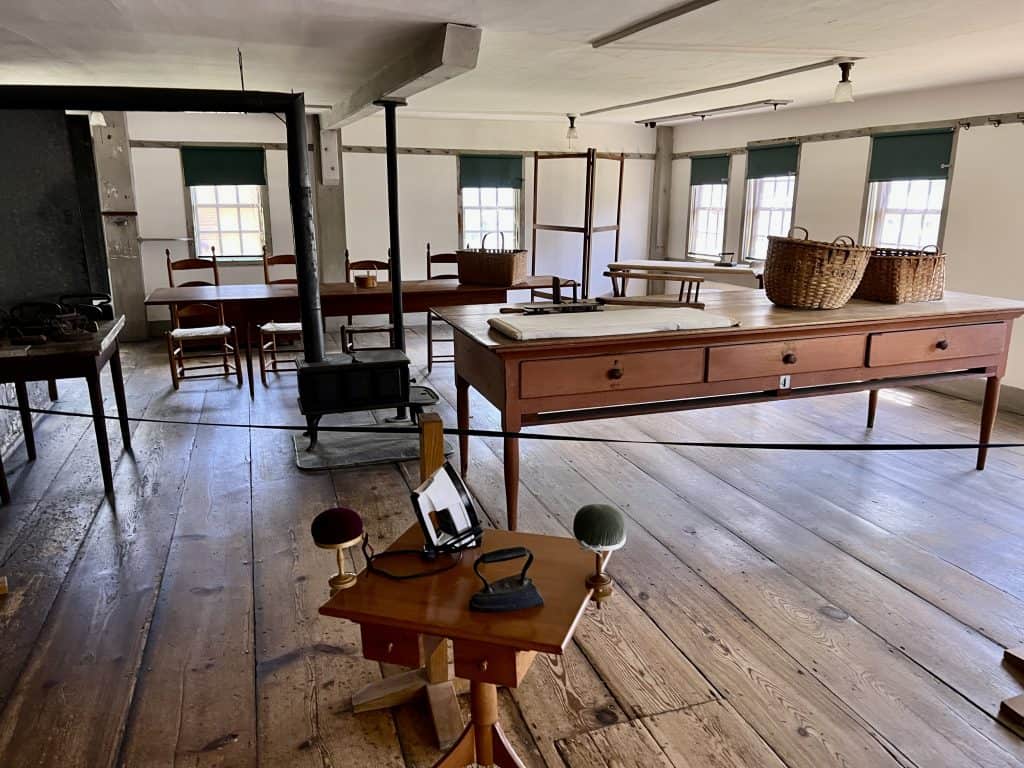
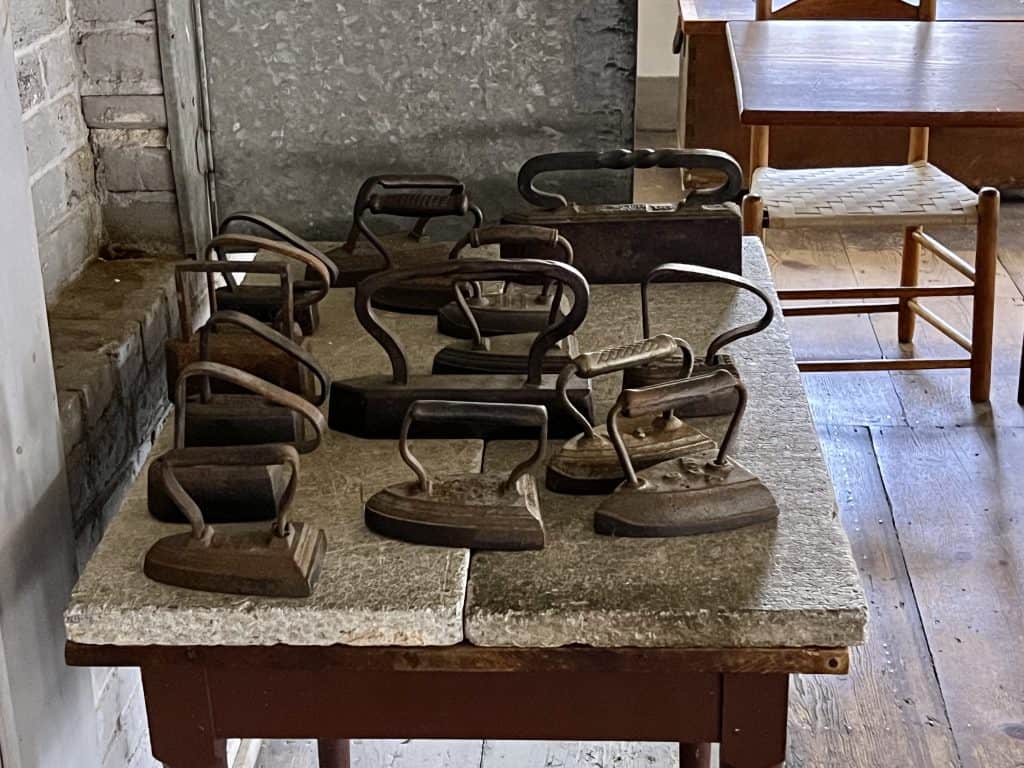
  4. The slabs of granite used as a base for an ironing board (they held the heat so much longer!) in the Spin Shop. 
  5. The original school desks in the School Building. The original one story schoolhouse opened in 1823 with boys going to school for three months in the winter and girls going to school for three months in the summer. When New Hampshire required 180 days of school and an addition was needed, the schoolhouse was jacked up and a new floor was added underneath (so as to not have to replace the costly, time consuming roof). Younger children went to school upstairs and older children went to school downstairs- still at separate times.  

Bonus: Try and count the number of wooden peg rails on the walls of every building (and just about every room!) They were used to hang everything from hats and clothes to chairs and brooms- the Shakers thought if you hung something when you were done using it, it would be more efficient to clean.

Looking for other living history museums that showcase the Shaker lifestyle? Check out our post featuring Hancock Shaker Village in Hancock, Massachusetts (the Berkshires). And for more fun in Concord, check out our post featuring the McAuliffe Shepard Discovery Center and the Pierce Manse. And follow along on our adventures on Instagram, Facebook, Pinterest, and Twitter. 

Disclosure: Our family was given a media pass to tour the Village; all opinions expressed are my own. 

Similar Posts

  • | | | | | |

    The Hew Hampshire State House in Concord, New Hampshire

    The New Hampshire State House, located in the capital city of Concord, is the home base of New Hampshire’s 24 State Senators, each Senator representing 55,000 residents, and 400 House Representatives, one for every 3,500 residents. State House members have other full time jobs and several college student members are current House members (the minimum age to be a House Representative is 18 years old). The House Chamber, 204 years old (in 2023) is the oldest, continuously used House Chamber in the United States- the only additions over the years have been carpet, electricity, and female representatives.   The original State House was built between 1816-1819, with additions in the 1860s and the addition of elevators and restrooms in 1910.

  • | | | | |

    10 Things Kids Will Want to Do at Hancock Shaker Village

    Traveling during a still present pandemic: If you’ve been following our adventures this summer, you know that our family has taken precautions to stay safe. We’ve limited our exploration to nearby states with lower COVID cases and to mainly outdoor spaces that take proper precautions to keep staff and visitors safe. Hancock Shaker Village was an easy choice- tons of open space to socially distance, only one family in a building structure at a time (with all doors and windows open to allow for better ventilation), and absolutely nothing to touch. While Hancock Shaker Village is a great place to visit anytime, it’s a very safe bet for family fun during these uncertain times.

    Celebrating its 60th anniversary in 2020, the Hancock Shaker Village is the oldest working farm in the Berkshires part of western Massachusetts. The Village was originally home to the Shaker community from the late 1700s until 1959, when it was turned into a museum that includes over 22,000 original artifacts and a research library. The 750 acre complex has a 20 acre working farm, 20 buildings with live interpreters, a massive garden with a very popular Community Supported Agriculture (CSA), and tons of hiking trails, meadows, and woodlands that abut the Pittsfield State Forest.

  • | | | | | |

    15 Ways to Explore the Seacoast Science Center in New Hampshire

    On a recent weekend in Portsmouth, New Hampshire we had the opportunity to explore the Seacoast Science Center, a marine science nonprofit with a beautiful, hands-on museum  located inside Odirone Point State Park, in Rye, New Hampshire. Opened in 1992, the center offers several, hands on indoor exhibits featuring maritime life, conservation programs, and the history of the area, as well as numerous programs and special events on (and in!) the water that the whole family will enjoy.

  • | | | | | |

    Exploring the New Hampshire Historical Society in Concord, NH

    While visiting the New Hampshire state capitol of Concord recently, we enjoyed a tour of the New Hampshire Historical Society, which celebrates the rich history of the Granite State.

    Celebrating its 200th birthday in 2023, the New Hampshire Historical Society was a gift of Edward Tuck, son of a wealthy businessman who founded the Dartmouth Business School, to the state of New Hampshire. Tuck gave most of his lifetime of fortune back to various charities in New Hampshire and ultimately wanted to build (what he called) a “temple” to the Granite State near the State House. Finished in 1911, the building takes up an entire city block and is diagonal to the State House in downtown Concord. Over the past century, several renovations have been made to the building to make it more energy efficient and accessible for all visitors. 

    The building was built in a Greek revival style, including the ceiling and walls of the rotunda, which are made of Siena marble from a quarry in Italy that was owned by the monks of the Old Convent and shipped to America. The floors and staircase are made of Hauteville marble from France. Make sure to stand in the middle of the atrium and look up at the Oculus and have children complete our “I Spy” game while touring the exhibits.

  • | | | | | | | | | | | | | | | | |

    Ten New England Cities to Explore during the Fall Season

    There is no more magical place (IMO) to be during the fall season than New England. (Sidebar: Although, I would probably say that for every season!). Many people descend on New England towns for the foliage, the festivals, and the food!.And while those are great reasons to visit, they won’t necessarily keep your kids as engaged as you might hope. A couple of years ago we shared this post about specific fall themed activities kids will love (and they ALL still hold true!) but this week we thought we’d share some places that have multiple activities the whole family will enjoy (and we’re including our “neighbors” in New York for a couple of bonuses.) These cities offer year round activities, but the beauty of fall is abundant in all of these spots. 

  • | | |

    15 Ways to Explore the Crane Estate on Castle Hill in Ipswich, Massachusetts

    On a recent visit to the North Shore of Massachusetts, we explored one of the most beautiful Gilded Age estates, the Crane Estate, set high on a hill above one of the most beautiful beaches, Crane Beach, in Ipswich, Massachusetts. The estate has been carefully restored and preserved by the Trustees, who oversee more than 100 properties throughout Massachusetts. 

    The Crane Company, founded by Richard Teller Crane, in 1855 was well known for their brass fixtures and bells, most famously used to help build the Golden Gate Bridge in San Francisco.  Later, his son, Mr. Richard T. Crane, who focused the company on manufacturing various bathroom fixtures, purchased Castle Hill and began renovating and expanding the property. The Cranes, who were based in Chicago, had summer homes in London, England and Jekyll Island, Georgia. The first home on the Ipswich property was built in 1912 but later torn down as it was properly outfitted to withstand the elements of the nearby ocean. The current estate, with 59 rooms, was built in a timeless English style similar to the Cranes’ London estate and finished in 1929. Over the years, the Cranes restored over 3,500 acres in Essex Bay, Choate Island, and Ipswich. The estate also includes the 700 acre Crane Wildlife Refuge, made up of Castle Neck (which borders Crane Beach), five islands, and salt marshes.

5 Comments

  1. I love visiting living history museums that showcase how people lived/live – they are so interesting. Adding this one to my list of places to visit when I get to the USA.

  2. This is really interesting! I have (of course) heard of Quakers, but not shakers. It is pretty cool that they built such an impressive forward thinking community starting with just 9 people! It’s really cool how many of their beliefs are important now, like equality of the sexes and finding cool technology to make lives better/easier.

    It is a bit of a shame that they closed to new members and slowly declined. It seems like they would have fit it well with modern society and could have different alternatives to capitalism…

Leave a Reply

Your email address will not be published. Required fields are marked *