Packing a Suitcase

You’ll hear me say it often on this site: Be prepared. I truly believe you can never be too prepared, or plan too much. And while it’s been a personal resolution (since, about, oh… 2002) to try and be spontaneous, I have a lot of evidence to support planning ahead of a trip.

I’ve written about how to pack the car, but if you’ll allow me to micromanage you just a little bit more, I’ve got a few suggestions on how – and what – to pack in a suitcase when traveling with the kids.
Pack a whole outfit for each whole day
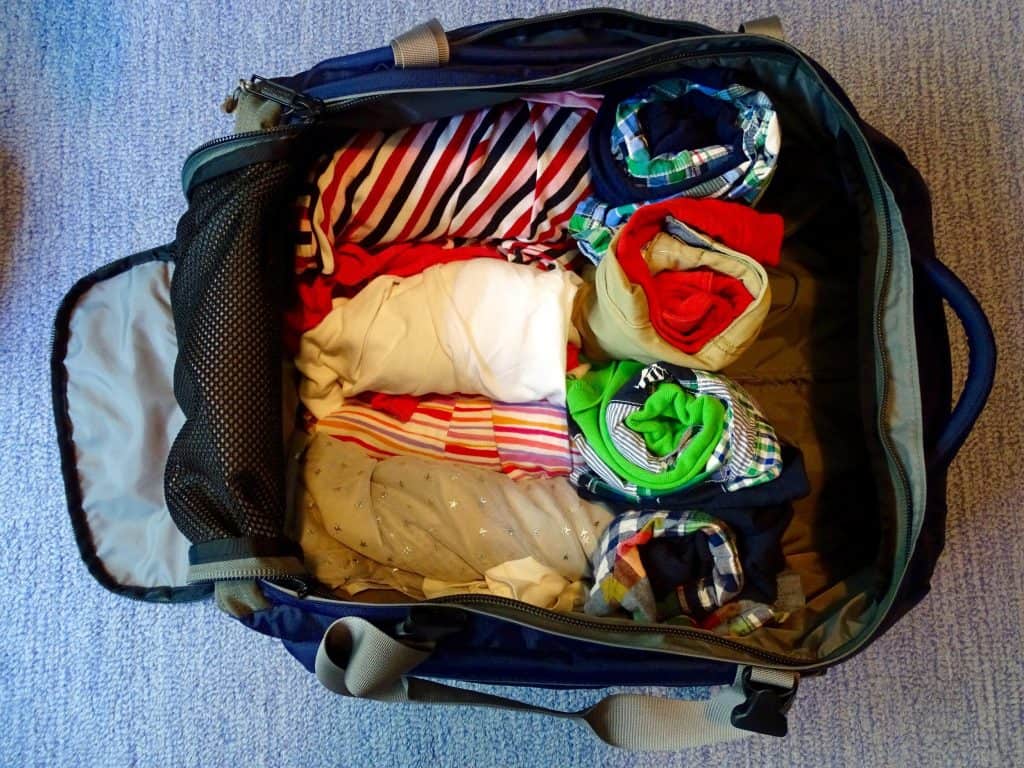
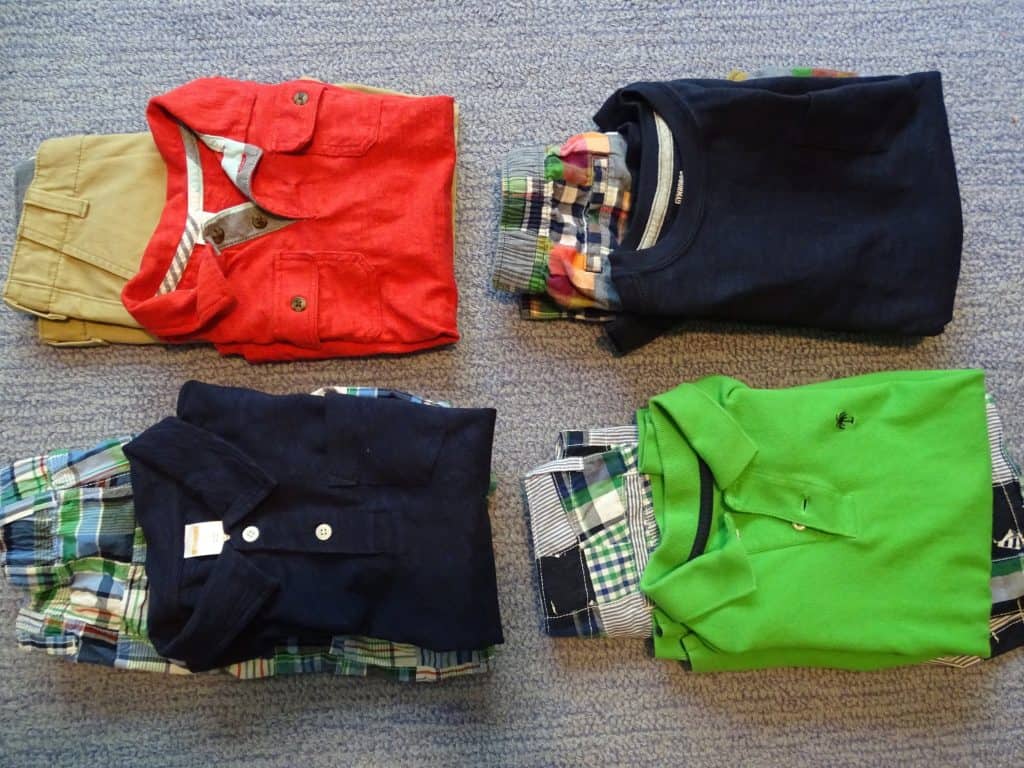
For each member of my family, I pack underwear, socks, tops and bottoms in one set. I used to try and coordinate my children’s clothes so they matched, but they stopped letting me do that years ago. I stack the items flat, with either the bottom or top item on the bottom, and then roll everything. This prevents the clothes from wrinkling, and I can easily see the colors and patterns.

Night time stuff
We shower at night, and recycle pajamas throughout the trip. I keep the pajamas in a separate compartment, so they’re easy to find after a long day, and will let them air-out on the desk or sofa to keep them fresh. Then I pull out a “roll-up” for the next day, so the kids can get dressed quickly in the morning. This prevents them from rummaging through the suitcase and making a mess.

Toiletries and cosmetics
We have two cosmetic bags we use: one to hold stuff we use on a daily basis – hygiene items like shampoo, deodorant, toothbrushes, etc, and one exclusively for my husband I that holds razors, lotions, and makeup. Hotels provide most of the necessities, but one of my nonprofit’s most popular community service projects involves making hygiene kits for homeless shelters using hotel toiletries… So, I often save the hotel toiletries for that, and bring along the products that fit our needs.
Would you like to save this?

We'll email this post to you, so you can come back to it later.

How many suitcases
I carry the “togetherness” philosophy right down to the suitcases. We don’t pack suitcases for each member of the family, but instead pack a few suitcases to share, that way we only have to lug around one suitcase at a time (as long as I can convince my husband he doesn’t need 2 shirts each day and multiple sweatshirts when traveling down South). I can usually fit 4-5 days of clothing for two adults and two small children in one suitcase. At the end of a hotel stay, we put the dirty clothes in a plastic bag in the trunk. When we’ve emptied a suitcase, we fill it back up with the bags of dirty clothes, leave it in the trunk, and move on to the next suitcase. Each suitcase has one set of pajamas and one bathing suit, so we don’t have to worry about switching things from one place to another. It’s important to have a spare blanket or retractable cargo shield that blocks the view of your belongings in the trunk, to help prevent a break-in.

What the kids are allowed to bring
Each child gets their own travel bag, which they’re responsible for carrying. The rule is: you bring it, you tote it. For night time, we only allow one small stuffed animal, and keep any special blankets in the suitcase with their pajamas, to keep everything clean. Our children are voracious readers. It’s a good problem to have, but the hardest part of packing is limiting the huge load of books our children want to bring with them. So we use a cloth basket in-between their car seats as a library and just leave it in the car. They can choose what books fill the library before each trip, and then select one book for nighttime reading, while the others stay in the car.

For other tips about staying healthy and happy while traveling, check out my posts here and here

Similar Posts

  • | | | | | | | | | | | |

    Our Summer 2020 Recap

    Summer 2020 wasn’t exactly what we were expecting, and it definitely wasn’t what we had been planning for a LONG time. June marked a milestone birthday for me and we had planned on celebrating with a big trip to places that have been on our bucket list for many year. Luckily, we rescheduled this trip for next summer- so cross your fingers and stay tuned!

    Each summer, we make individual “Bucket Lists” of things we want to do. Some common goals that the four of us shared are part of the highlights below. We’re grateful we were able to accomplish so much and fully recognize how fortunate we are. Here are the highlights:

    Once the pandemic hit, we knew we’d have to shift our perspective and our travel plans. Our major goals for any trip include: staying safe and healthy; doing our best to keep others safe and healthy; respecting local and state guidelines and regulations; learning new things; having fun.

  • | | | | |

    National Park Guide: Arches National Park in Utah

    Arches National Park in Moab, Utah, one of the most popular National Parks in America with two million visitors each year, is home to over 2,000 cataloged arches formed by erosion and weathering over the past 65 million years. Learn more about how the arches were formed here. Today, the park covers over 76, 000 acres and, in addition to the arches, is home to almost 500 species of plants, almost 200 species of birds, 50 species of mammals, 21 species of reptiles, and 6 species of fish (yes- fish!)

    We visited in June of 2021, during the still on going COVID pandemic, and there were some restrictions, mainly with the Visitor’s Center and programs. We highly recommend visiting early in the morning (being inside the park by 6am early), spending the morning hiking, and then leaving the park for lunch and a rest during peak afternoon sun. Later afternoon and evening will provide cooler temperatures and smaller crowds. Be careful to stay away from cactus and yucca plants, both of which are prevalent throughout the park. Both plants have sharp tips that can poke and easily puncture skin.

  • | | | | | | | |

    Federal Hall National Memorial in New York City

    Regular readers will recall my passionate enthusiasm for the National Park Service. A quick search on my blog and you will find dozens of sites we have visited- check them out here. Whenever we travel or visit  a new area, I always check for any nearby site- the Park Service has an app and website for searching sites. On a recent trip to lower Manhattan to explore the Fraunces Tavern Museum and National Museum of the American Indian, we realized we were less than a half mile from Federal Hall National Memorial and decided to visit. 

  • | | | | | | | | | | | |

    15 Things to Do with Kids in Boston, Massachusetts

    I’ll disclose that Boston is my hometown, so this post will be “wicked” biased. But even the biggest Yankees fan will admit that the birthplace of the American Revolution, the home of winning sports teams, waterfront activities, world class arts and culture, and curator of foods like Fenway franks, bakes beans, chowdah, and Boston Cream Pie, is one of the most special places in the world. There are SO many family friendly activities you’ll need weeks years to see and do it all, but for our latest City Guide we’ll start with these 15 places the whole family is sure to love.

  • | | |

    New York State Capitol Building

    Albany, New York, located just two hours north of famed New York City, was established by the Dutch in the early 1660s. I recently did some research for family centered activities in the area, as my family drives past Albany a few times a year on our way to visit close friends in Utica, New York. On a recent trip, we stopped to explore the New York State Capitol building, at the top of the State Street hill. The “current” Albany State Capitol took over 20 years to build, post Civil War. The building has gone through many phases of of restoration, as recently as the early 2000s.

    Tours of the Capitol are offered four times a day during the week and twice on Saturday. Tours are free, but reservations are highly recommended (go here), as they are usually limited to 25 people and quickly fill up. Tours are very different during the week, when everything is in session and the entire building is bustling with elected officials. If you prefer a calmer experience, the weekend tour is a safer bet, but you’ll miss the chance to possible see elected governmental officials.

  • | | | | | |

    10 Galleries Kids Will Love at the Cloisters in New York City

    The term “cloister” refers to an open courtyard, usually found in the center of a religious monastery or convent. Located in Fort Tryon Park in the Washington Heights section of Manhattan, the Met Cloisters are an extension of the Metropolitan Museum of Art that showcases European medieval art and architecture. There are a dozen distinct areas that include 20 galleries and gardens spread throughout the four acre space. The museum was built by architect Charles Collens and opened in 1938. Many of the artifacts and structures, which date back to the 12th through 15th centuries, were saved from various churches, monasteries, and abbeys throughout Europe and recreated throughout the museum complex. There are several stone and wood sculptures, panel paintings and tapestries on display throughout galleries that are meant to recreate the feeling of being in a medieval European monastery. The four cloisters were originally created in France, bought by art dealer and sculpture George Barnard in the early 1900s, and later bought by John D. Rockefeller and donated to the museum.