10 Things Kids Will Want to Do at Hancock Shaker Village
Traveling during a still present pandemic: If you’ve been following our adventures this summer, you know that our family has taken precautions to stay safe. We’ve limited our exploration to nearby states with lower COVID cases and to mainly outdoor spaces that take proper precautions to keep staff and visitors safe. Hancock Shaker Village was an easy choice- tons of open space to socially distance, only one family in a building structure at a time (with all doors and windows open to allow for better ventilation), and absolutely nothing to touch. While Hancock Shaker Village is a great place to visit anytime, it’s a very safe bet for family fun during these uncertain times.
Celebrating its 60th anniversary in 2020, the Hancock Shaker Village is the oldest working farm in the Berkshires of western Massachusetts. The Village was originally home to the Shaker community from the late 1700s until 1959. It then reopened in 1961 as a museum that includes over 22,000 original artifacts and a research library. The 750 acre complex has a 20 acre working farm, 20 buildings with live interpreters, a massive garden with a very popular Community Supported Agriculture (CSA), and tons of hiking trails, meadows, and woodlands that abut the Pittsfield State Forest.


Travel Tips:
For 2020, follow the arrows around the one way path throughout the complex. This helps ensure social distancing and gives everyone plenty of space.
Wear sneakers and bring the stroller for the toddler crew. There are only a couple of places to sit throughout the complex and the one way path is paved with grass, gravel, or dirt.
The Village is traditionally open from April through October, with special events on weekends in November and December. Check here for the calendar and times and check here for a list of special tours.
The Village hosts a wide variety of special events, concerts, and family activities- check here for the list.
The Village is mostly handicap accessible, but does involve a good amount of walking. Some buildings (mainly the Brick Dwelling) have second floors that are not handicap accessible.
An audio tour is available and download the app for plenty of trivia about the Shaker lifestyle and beliefs.
Check in at the Welcome Center to purchase tickets (check on promotions and discounts here), use restrooms (the only accessible ones on property), and visit the Shaker Mercantile Shop, which offers a wide selection of children’s apparel, books, and toys; housewares; stationery; and reproduction Shaker style furniture..
The Seeds Market Cafe serves lunch, snacks, and drinks and is open for dinner during special events.
Plan on two to three hours to fully explore the entire complex. Children might want to spend more time in the Discovery Barn and avid hikers might want more time on the trails. Check here for a good overview.


10 Things Kids Will Want to Do at the HS Village:
1. Look out for the “Fun Finds” posters displayed throughout the complex. The posters share trivia kids will enjoy, like what Shakers ate for meals and the names for various baby animals, and challenge kids to complete special activities.
2. Walk round and round the Round Stone Barn, built into the hillside of the farm; It’s the only round Shaker round barn in the world. The 1814 barn was built twice (after a fire destroyed the first one) and housed dozens of cows. The shape of the barn made it easy for the farmer to efficiently milk the cows. Don’t miss the second floor, which displays dozens of large farming tools including an ox shoeing frame.




3. Play I Spy to find your favorite fruit or vegetable located in the gardens or orchards. The medical herb garden alone has 75 varieties of herbs that cure various ailments (be sure to read the signs that explain each one). Keep an eye up, too, to see a variety of apple trees, which are used to make a special cider.
4. Meet the goats, sheep, donkeys, and pigs and piglets who call the Dairy Ell home. The structure was built in the 1930s and where dozens of the animals eat and sleep. Don’t miss the placards that share each animal’s name and parent (there are a few sets of twins!) Note: Keep a close eye on the toddler crew, who will be tempted to reach in through the very wide fence to pet the animals.


Would you like to save this?
5. Try “talking” with the roosters and chickens in the Wood Poultry House- if you “baah” at them, they’ll often reply! And visit during the hours of 10am-1pm, when the sheep and goats are grazing in the field.
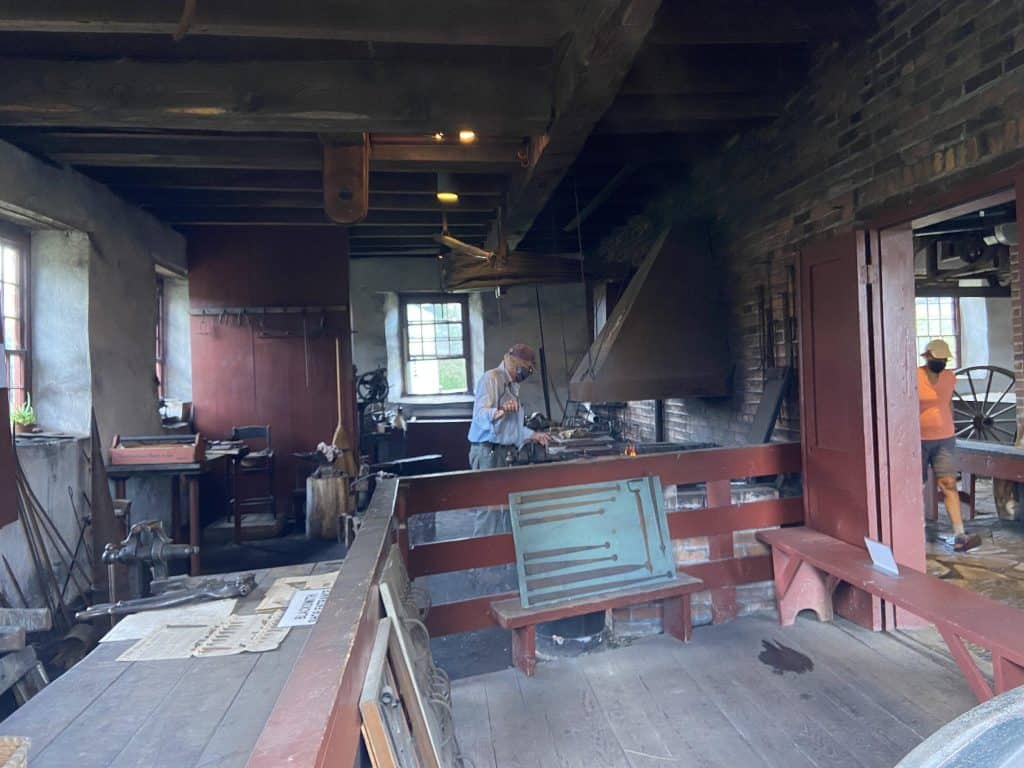
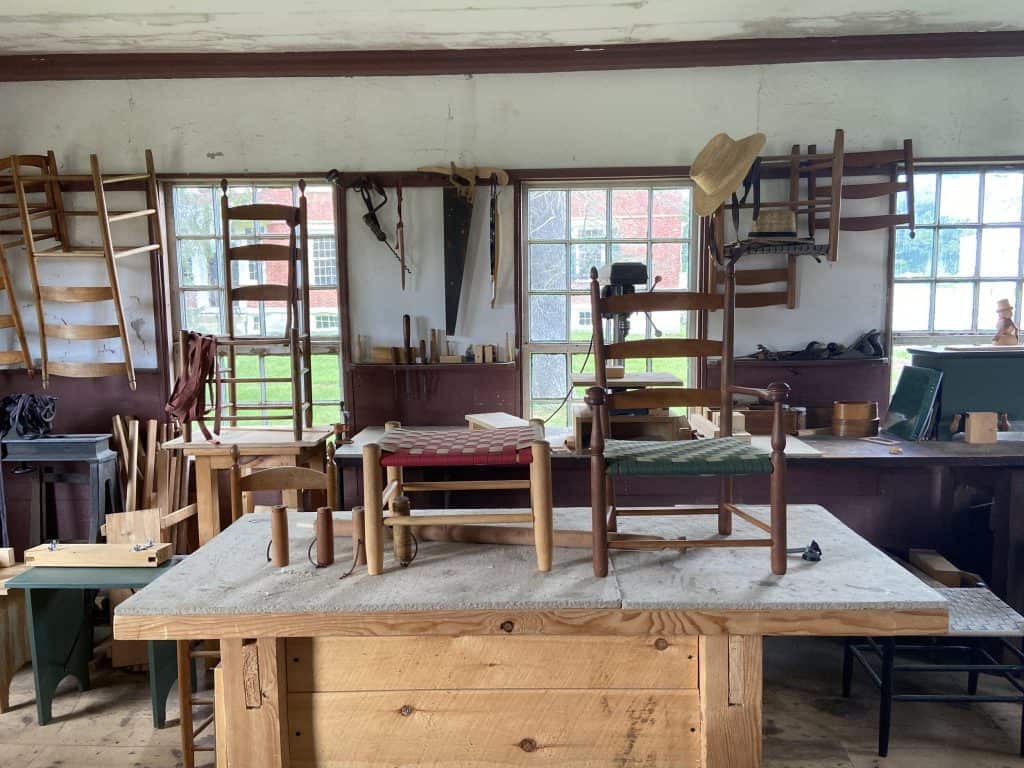
6. Learn how the Shakers made their famous oval boxes and Shaker style furniture in the Tannery, Brethren, and Blacksmith shops. All three buildings have live interpreters who will explain the various tools, materials, and processes to making items that are still very popular today. Check out the artist in residence binding books and painting, using dyes from the fruits and flowers in the garden. Ask at the Welcome Center for the schedule for the day.
7. Figure out laundry was done in the Red Barn Laundry Shop. The shop even has it’s own ironing room. When electricity was introduced in 1913 to the Shakers, the water powered machinery was no longer needed and the process became less strenuous.






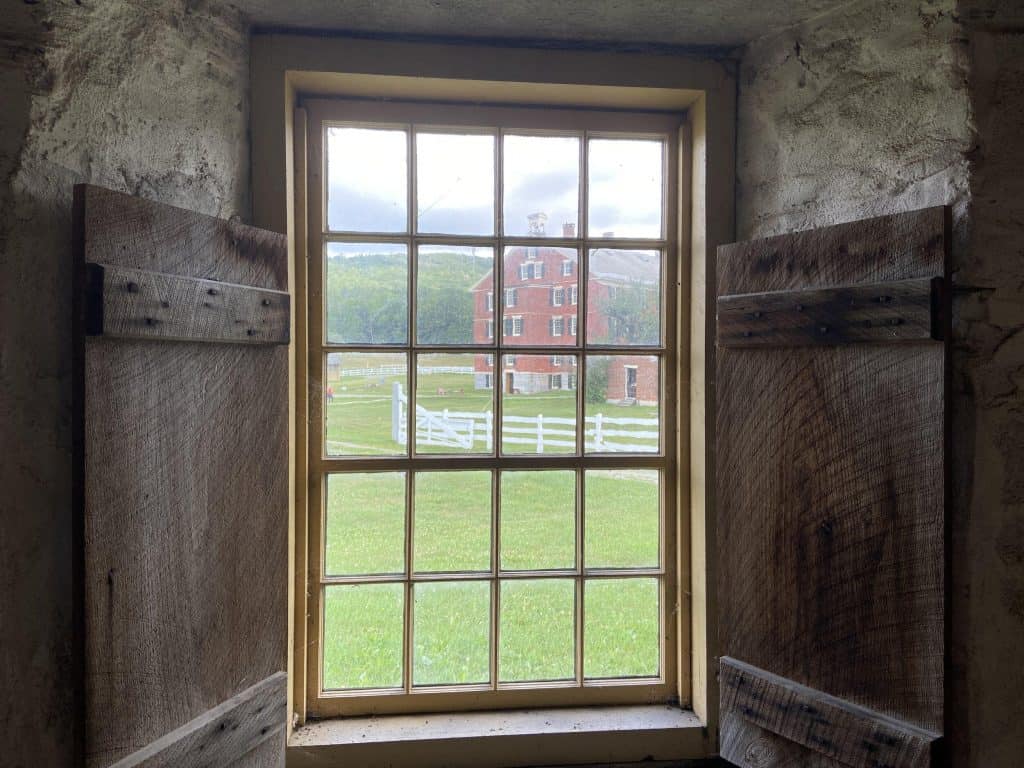
8. Explore the 1830s Brick Dwelling, a massive four story house, wherever over 100 Shakers slept, ate, and worshipped. Guests can explore three floors starting with the kitchen on the ground floor, dining rooms and worship rooms, and finally bedrooms and nurse’s shops on the top floor. The building is comprises of over 350,000 bricks, 100 full size doors, and 144 windows!
9. Walk the mile long Farm and Forest Trail, a level trail through the woods. Signage explains how the Shakers used the land for every facet of life. Across Route 20 is a more ambitious six mile hiking trail- grab a map at the Welcome Center.
10. Try your hand at many farm activities in the 1910 Discovery Barn, which was once home to 30 Holstein cows. Kids will surely want to linger here, where they can try looming and spinning and even pretend to milk a cow. Note: Due to state restrictions for summer 2020, the Barn is not open to visitors.


Note: Our Top 10 list were the activities our children found most engaging. There are several other buildings families might enjoy, including the Horse Barn and Schoolhouse (located across Route 20), Ice House, and the 1915 garage (which stores an original 1923 REO automobile sedan). Adults will enjoy the “Notes About Home” indoor exhibit at the Welcome Center celebrating the Village’s 60th anniversary. Families could easily spend the better part of the day exploring every building.


Stay tuned for future posts on other family friendly activities in the Berkshires. And for other living history museums, check out our adventures at Old Sturbridge Village, Boston Tea Party Ship & Museum, Minute Man National Historic Park, Mystic Seaport, American Revolution Museum at Yorktown, Jamestown Settlement, and Maine Maritime Museum.

Disclosure: My family received a media pass to explore Hancock Shaker Village. All opinions expressed are my own.